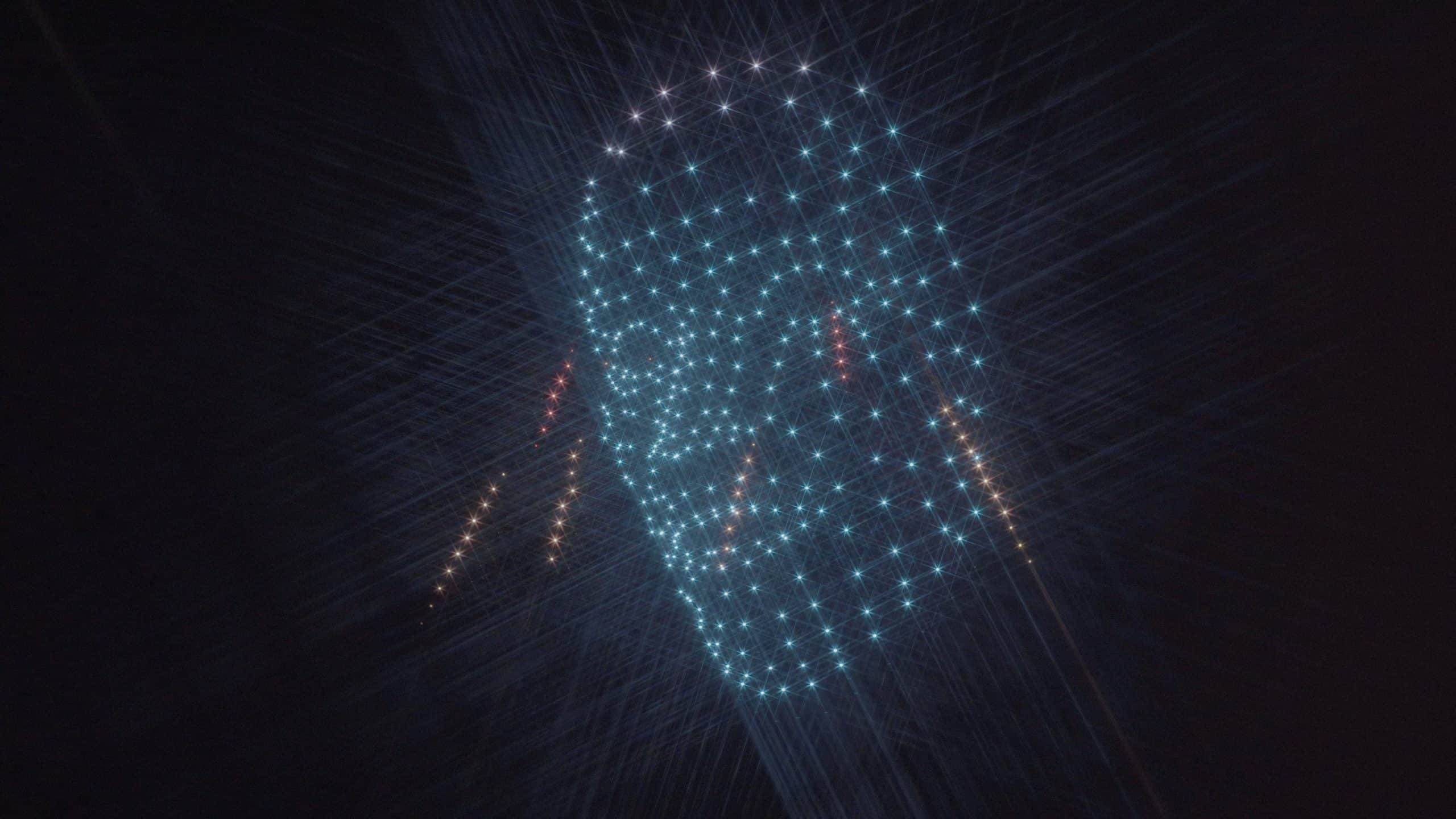
When a drone show is compared with fireworks, the conversation usually ends in «one or the other». That comparison makes sense, and we made it in drone show vs fireworks: how to choose. But more and more organisers are asking the question differently: what if the night has both?
And you do not always have to choose: a drone show can be combined with fireworks on the same night, each where it works best. It is not a compromise. Done well, the combined show gives something neither gives alone, because each format is good at different things and the audience can tell.
This article is about how it is put together: what each one brings, how the night is shared out, how script and music are shared, how the two teams coordinate and what space each needs. It is written for whoever programmes a festival, a town’s festivities or a large event, and also for the fireworks company that wants to add drones to its offer.
Already have fireworks and want to add drones?
Tell us what is programmed and where, and we will propose how to fit the flight with the pyrotechnics: order, duration and what each team needs. The proposal, in under 48 hours.
Índice de contenidos
ToggleWhat each one brings
The key to a combined show is not asking each format to do what the other does better.
Fireworks bring what has worked at celebrations for centuries: the bang you feel in your chest, the sheer volume of light filling the whole sky, colour that bursts and fades, and a tradition that in many places is part of the festival’s identity. For a finale, nothing fills the sky like it.
Drones bring something else: they draw. They can form the town’s coat of arms, the name of the festival, a date, a character or a logo, and turn one figure into another. They tell a story with a beginning and an end, and hold it in the sky for as long as it takes to be read. And they do it silently, so the soundtrack is whatever music you choose.
Put together, the split almost makes itself: the drones tell the story and the fireworks celebrate it. People remember what they saw drawn and feel what burst overhead.
How the night is shared out
There are three basic ways to order the two formats. None is right in general: it depends on the site, the usual wind and what you want to tell.
One after the other
Drones first and fireworks as the finale, or the other way round. It is the simplest structure to set up, because each team has its block and the sky to itself for that time. Starting with drones has a practical advantage: the sky is clean. Fireworks leave smoke, and if the wind pushes it towards the audience, any figures that come afterwards are seen through a haze.
In alternating blocks
Drones, fireworks, drones, fireworks, like chapters. It works well when the show follows a story: the drones set up each part and the fireworks close it. It needs tighter timing and a careful eye on smoke between blocks.
Together, at specific moments
Drones and fireworks sharing the sky at the climax. It is the most spectacular option and the one that takes the most design, because the two formats use different spaces and the design has to ensure the drones do not cross the firing zone while fireworks are going off. It is planned for short, defined moments, not for the whole show.
One script and one soundtrack for both
A combined show needs a single script, not two shows back to back. That shows above all in the music. Drones fly a choreography programmed to the second, and modern fireworks can also be fired in sync with music using electronic firing systems. If both teams work to the same track and the same timecode, the handover from one format to the other becomes part of the show rather than a gap.
In practice the script is agreed three ways between the organiser, the fireworks company and the drone team: what is told at each moment, how long each block lasts and at exactly which second the lead changes hands. How the drone part is designed, from idea to premiere, is in how a drone show is made.
Want to see how it would fit your event?
With the site and the programme in front of us, we can tell you which order works best there and what each team needs to work alongside the other.
Coordinating with the fireworks company
A combined show goes well when there is one clear lead and the two teams know each other before the night. These are the pieces not to leave to chance:
- Who holds the contract. It can be the fireworks company, the drone operator, or the organiser with two contracts. In Spain, for example, many councils book the whole show through the pyrotechnics company that already does their fireworks. What matters is a single point of contact for the organiser.
- A joint site visit. To fix where the drones take off, where the firing zone is and how each team gets in and out.
- A shared safety plan. With each team’s zones, access routes, emergency cover and set-up times.
- One communication channel on the night. For the countdown, each block’s cue and any stop.
Technical compatibility helps too. We fly with the industry’s reference software, which is compatible with other systems: that simplifies coordination when the show shares a production with third parties.
Space, distances and permits
Each format has its own safety rules and its own authorisations, and in a combined show they add up rather than merge. Fireworks work with their firing zone and safety distances, set by their own regulations and permit. Drones need a take-off area separated from the public and a clear flight space, set by the aviation authorisation. The exact figures depend on the material, the site and each permit, so there is no point giving them in the abstract.
What does hold in general is that those zones are designed together during the site visit, so they do not overlap, and that wind matters for both: for drones because of flight limits, for fireworks because of where debris and smoke fall. Sometimes the usual wind alone decides what goes first.
As for the paperwork, each team handles its own. On our side, we handle all the permits with the aviation authorities and with the council. Depending on where and how the flight takes place, the file goes to one body or another; that is our job. What a drone show requires is set out in drone show permits in Spain.
Frequently asked questions
Can it be done with any fireworks company?
Yes, as long as there is coordination from the start. Both companies need to share the script, the music and the safety plan, and someone has to take charge of the night.
What if one of the two cannot perform?
Each team decides on its own part on safety grounds: drones, for example, do not fly when the wind is above the operating limits. That is why it is worth agreeing in writing what happens if only one of the two can go ahead. More in rain or wind on the night.
How many drones does a combined show need?
The same criteria as a drones-only show: what you want to draw and where it will be seen from. We cover it in how many drones does a show take; we work from 150 drones up to 7,000.
Does it work on New Year’s Eve?
It is one of the nights when it comes up most, with one particularity: midnight sets the time. More in Christmas drone show.
Who flies the drones?
In our case, our own team. We design, build and fly our own drones, and the team that operates them is ours: we do not subcontract the flight. We have done more than 500 shows.
Where to start
Three facts are enough to start designing a combined show: the site, the date and what is already booked. If the fireworks are already settled, even better: we start from their plan and look for where drones add most. If nothing is booked yet, both parts are designed together from the script.
Tell us about your event and we will propose a running order that works at that site.
Drones and fireworks, in the same script
- ✓A proposal in under 48 hours, with the order that works at your site
- ✓Coordination with the fireworks company: shared script, music and safety plan
- ✓All the permits handled for the drone part
- ✓Our own team and drones: we do not subcontract the flight
Fireworks already booked? Tell us about your event