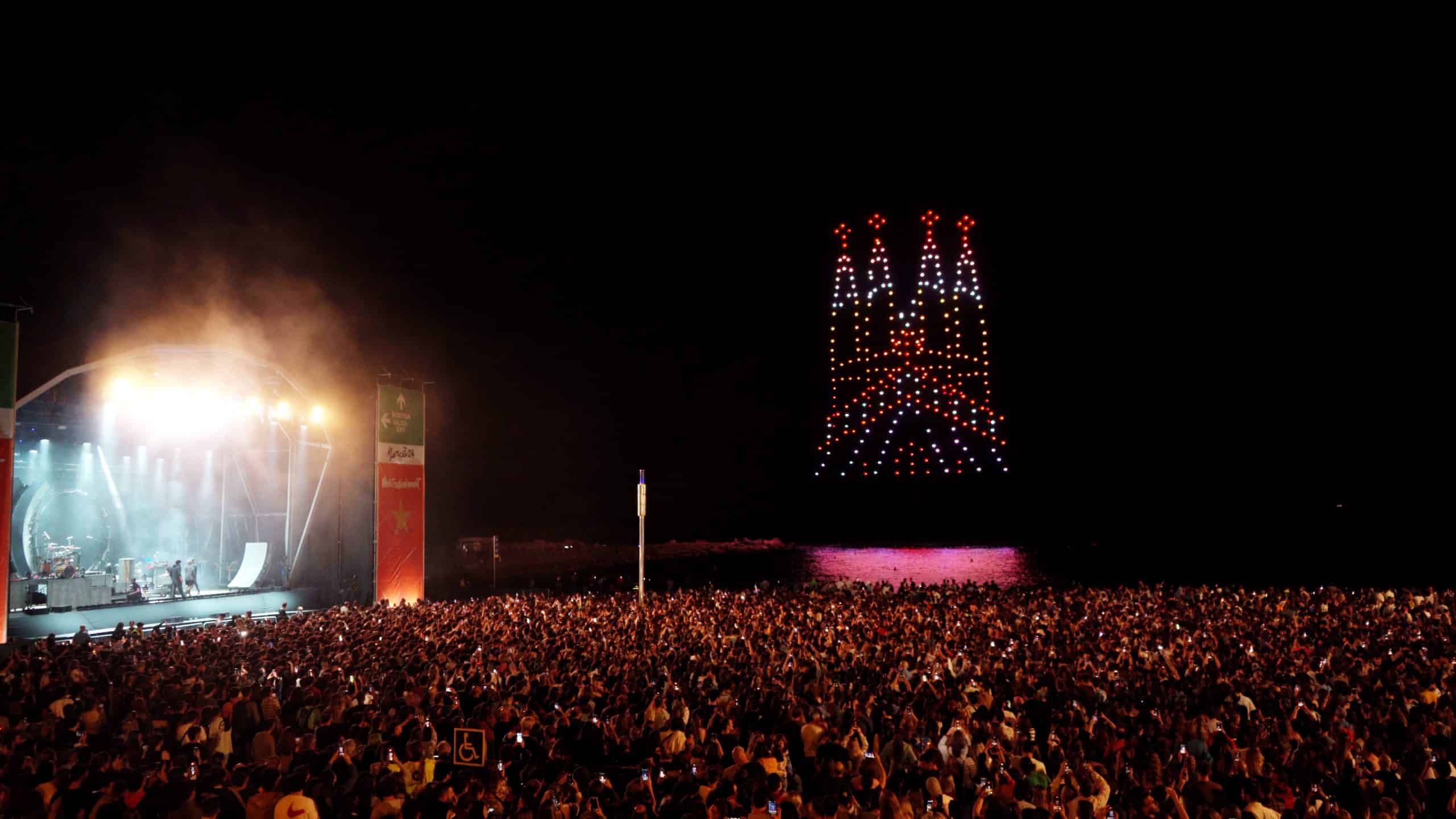
Sooner or later someone asks it out loud. The councillor who has to defend the budget at a council meeting, the manager of a venue, the neighbour who hears that hundreds of drones are going to fly over their beach: what if one falls?
It is a fair question, and the short answer is that a well-planned drone show does not rely on nothing going wrong. It relies on nobody being underneath if something does. Safety is not added at the end: it is the first thing drawn on the site plan, before any figure.
Here is how that safety is designed and, above all, how you can check it yourself, whether you are the one hiring the show or the one watching it.
Do you have to answer this question at the council or at your company?
Tell us where you want to hold it. We will explain how the flight area and the audience area would be laid out at that site, so you walk into the meeting with answers.
Índice de contenidos
ToggleThe basic idea: nobody under the figures
It all starts from a simple rule: there is no audience under the choreography. The drones fly over a space that has been left empty on purpose, whether water, open ground or a closed section of the venue, and people stand outside it, with a margin.
It is the logic applied to anything that flies over an event: you do not just trust the aircraft to work, you arrange the space so that a failure has nobody to reach. That is why a drone show is not designed starting from the figures but from the site plan: where people are, where they cannot be and where the figures fit with that margin.
Under the European framework, a show like this is not a recreational flight: it falls into the specific category and is authorised on the basis of a risk assessment of that particular operation, at that site. Distances and zones do not come from a generic table: they come from that assessment.
The zones of a show, on the plan
If you ask for the operation’s site plan, and it is worth asking, you will see several zones that never overlap:
- The take-off and landing area. On the ground, closed, for the operator’s crew only. It is where the fleet sits before and after the flight.
- The flight volume. The space in the air where the figures are drawn, with its height and width. Nobody underneath.
- A buffer around it. A cushion between the flight volume and any person, to absorb the unexpected.
- The audience area. Outside all of the above, with its access points and exits.
How big each one is depends on the size of the show, the height of the figures, the surroundings and the authorisation. There is no number that works for every case, and be wary of anyone who gives you one without having seen the site. What must be clear is where each line is and who watches it on the day.
What happens if a drone fails
This is the real question, so it is best answered plainly. A drone can fail: a battery, a motor, a loss of position. In a show with hundreds of aircraft, the industry works on the basis that this can happen and plans what to do in each case. Common practice looks like this:
- Continuous monitoring. From the ground station, the status of every drone is followed throughout the flight: battery, position, communication.
- A geofence. A virtual boundary around the flight volume. If a drone approaches the edge or crosses it, the response the operator has set is triggered: stopping it, landing it or switching it off inside the safe area.
- A procedure for each failure. What a drone does if it loses signal or runs low on battery, and where it goes. Typically it has a planned response that takes it to an area with no audience.
- The ability to stop the whole show. The pilot in command can halt the entire fleet if something is not going as it should.
It all points the same way: a drone with a problem ends up on the ground inside the empty area, never outside it. Each operator has its own procedures and technology, so the useful way to check is not to read an article but to ask yours: what does a failing drone do, and where does it end up?
Safety shows on the plan, not in the brochure
Before you sign, ask for the zone plan and the failure procedure for your show. This is how we approach drone shows for events.
Weather is a safety decision too
Wind, rain, fog or a thunderstorm do not just make the show look better or worse. They change how the drones behave and, for that reason, they are part of the decision to fly. That decision is made by the pilot in command within the authorised limits, and it is not up for negotiation: if conditions do not allow it, the show does not fly. How and when the call is made, and what is agreed for that case, is in what happens to a drone show in rain or wind. One idea is enough here: an operator who flies in any weather so as not to lose the date is not being more professional, quite the opposite.
How it is proven: the documents to ask for
A show’s safety is not proven with a nice video. It is proven with documents that exist before the flight and that any organiser can ask for without being an expert:
- The operation’s authorisation. The show has to be authorised for that site and that date. What that involves is explained in drone show permits: who handles what.
- The zone plan. Take-off, flight, buffer and audience, drawn over the real site.
- The failure and emergency procedure. What happens if a drone fails, if someone enters the zone or if the flight has to be stopped, and who tells whom.
- Third-party liability insurance. That it exists, that it covers this kind of operation and that it is valid on the date of the event. It is one of the checks we suggest in how to choose a drone show company.
- Who flies. The pilots in command, and whether the crew belongs to the operator or is subcontracted.
We handle the full management of permits with the aviation authorities and with the council; depending on where and how the show flies, the application goes to one body or another. And the crew that flies is our own: we do not subcontract the flight. If a supplier cannot show you any of these documents, or answers with generalities, you already have your answer.
Six questions to ask the operator
- Where will the audience be, and why at that distance?
- What is under the figures throughout the flight?
- What does a drone do if it loses signal, position or battery? Where does it end up?
- Do you use a geofence? What happens when a drone reaches it?
- Who can stop the show, and in what cases?
- What exactly does the insurance cover, and until when is it valid?
The answers do not have to be technical to be good. They have to be specific, about your site and not about shows in general.
What falls to the organiser
The operator designs the safety, but on the day there is a part that only whoever controls the venue can deliver: making sure the zones on the plan really exist. That nobody enters the take-off area, that the audience stays where it should, that access and exits are clear and that the event’s security team knows the same as the operator. The practical detail is in what to prepare for the day of the show. Two things are enough here: name one person on your side as the contact for the flight crew, and do not let anyone, however important, cross the lines for a closer look.
If you will be in the audience
For the people watching, safety comes down to a few simple things:
- Stay in the audience area marked by the organisers, even if the view seems better from somewhere else.
- Do not fly your own drone, not even to film. That airspace is reserved for the authorised operation.
- If you see something odd, such as a person inside the closed area, tell the event staff.
- If you find a drone on the ground, do not touch it or take it home as a souvenir: it has a battery. Tell the organisers.
- When it ends, leave calmly and by the marked exits: that is when the most people move at once.
Frequently asked questions
Can a drone fall on the audience?
A well-planned show is designed so that it cannot: the audience is not under the figures and the procedures send a drone with a problem towards the empty area. That is why it is worth checking the plan and the failure procedure, not just the fleet.
Does a small show need less safety?
It needs the same logic on a different scale. With fewer drones the zones can be smaller, but the rule of having nobody underneath does not change.
Who is responsible if something happens?
Broadly speaking, the operator is responsible for the flight operation, which is what the liability insurance is for, and the organiser is responsible for the event and its security arrangements. So each party should know what falls to them, in writing.
In short
A drone show is safe when it is designed so that a failure cannot reach anyone: the audience outside the flight area, a buffer around it, a planned response for each failure and one person with the authority to stop. None of that is invisible: it is in the plan, the authorisation, the procedure and the policy. Ask for them and you will have the answer for the council, for your management and for the neighbour who was asking.
Write to us with the place and the date and we will tell you how we would approach it. Or see first how we work on drone shows.
Safety is drawn before the figures
- ✓We design, build and fly our own drones: we do not subcontract the flight
- ✓Full management of permits with the aviation authorities
- ✓More than 500 shows in more than 15 countries
- ✓We reply in less than 48 hours
Already have a date and a place? Tell us about your event