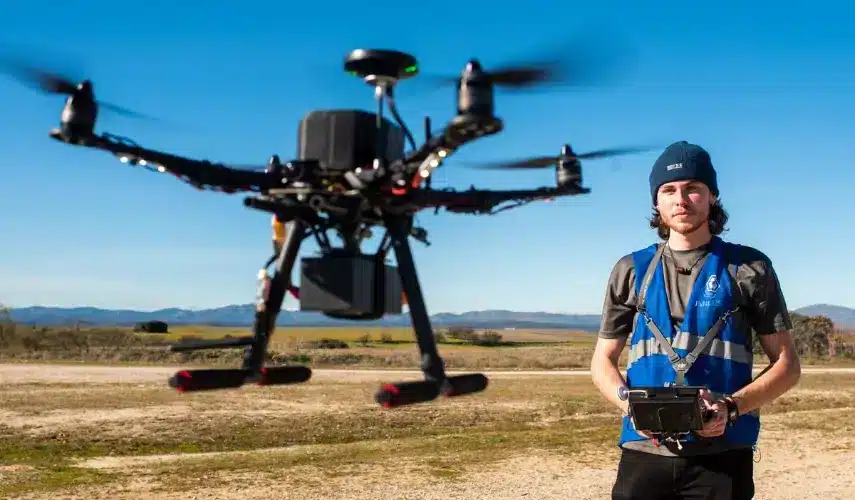
Preparing for the STS-01 and STS-02 standard scenarios is a decisive step for any pilot who wants to operate in the specific category. These accreditations, regulated in Spain by AESA, open the door to more demanding work: flights in urban areas, BVLOS missions, technical inspections and jobs in surveying, industry or security.
This guide covers the current official syllabus, the first practical steps, the study material you actually need and a plain explanation of the rules in force. If your goal is to become a professional drone pilot, this is where it starts.
The syllabus is the map. The exam is the destination
Downloading the PDF is the easy part; getting through the STS assessment takes structured study and practice. Our STS course covers both, ending with the AESA evaluation.
Download the STS-01 and STS-02 syllabus, free
The first step is to download the STS syllabus as a PDF: the document that lists everything AESA examines. It covers the regulations, the aeronautical fundamentals and the operational procedures you will need to master. Working from up-to-date material matters here, because the European framework keeps moving.
You can download the complete STS-01 and STS-02 syllabus PDF. Note that the document is published in Spanish, which is the language of the AESA examination.
STS-01 or STS-02: decide before you start studying
One is VLOS over a controlled ground area, the other BVLOS with airspace observers. They open different kinds of work, and knowing which you need saves you studying twice.
First steps towards your STS
Before you start studying, it helps to be clear on how the two scenarios differ. STS-01 covers VLOS operations in controlled or urban environments, while STS-02 is built for BVLOS operations over sparsely populated areas. You will also need to register as a UAS pilot, register as an operator and put together the documentation AESA asks for. Starting that process in order saves a lot of backtracking later.

What the official syllabus contains
The official STS syllabus spans a wide range of subjects: aerodynamics, European regulation, aeronautical communications, human factors, meteorology, how UAS work technically, and emergency management. Going through each module in order is what builds a solid grasp of everything the theory exam will ask.
Study guide for the specific category
Studying for the specific category needs a plan. This guide sets out how to distribute the content, which modules deserve more attention, how to read the regulation through worked examples, and which study methods actually work. Structured study does not just help you understand the material — it makes it stick.
Up-to-date AESA material
AESA publishes updated STS material regularly: technical guidance, regulatory updates, operational documents and the checklists you need to prepare an operation properly. Keeping up with that material is what guarantees you are studying against the current legal framework rather than last year’s.

The full theory syllabus
This is the compulsory theory content in full: principles of flight, applied aerodynamics, UAS architecture, human factors, how weather affects an operation, communications, standard procedures and emergency management. It is the foundation of the STS exam and of flying professionally and safely.
Regulation and legislation in force
The regulation is a core part of the exam. This section works through Regulation (EU) 2019/947, Delegated Regulation 2019/945, the operational categories, UAS geographical zones, flight limitations, and the responsibilities of the pilot and the operator. Understanding it is not only how you pass — it is how your operations stay legal.
Royal Decree 517/2024, approved on 4 June 2024, sets out the legal framework for civil drone use in Spain. It aligns with the European regulation and governs the key national aspects.
Operational procedures
Operational procedures define how an STS mission is flown safely: prior planning, site assessment, aircraft preparation, running the mission and what to do in an emergency. They also set out the criteria for reducing risk and keeping third parties safe throughout.
Flight safety
Safety is the backbone of any operation. This section covers how to identify risks, prevent incidents, handle adverse conditions and recognise the signs of a failure developing. It also goes into human factors and into making the right call under pressure. A safe pilot is an effective pilot.
Mission planning
Planning a mission properly is not optional. Here you work through preparing the flight area, studying the airspace, reading the weather and building operational routes. It also covers checking the state of the equipment and coordinating each phase of the operation.
- Proper planning raises the safety and the success rate of any STS operation considerably.
Preparing for the exam
The final stage is preparing for the assessment itself: which study methods work, how to run mock exams properly, the mistakes to avoid, and how to walk into the exam calm. With a plan and some consistency, passing the STS is a far more manageable process than it looks from the outside.
The specific category is where the paid work starts
- ✓Training approved by AESA, the Spanish aviation authority
- ✓Real flight practice, not just theory
- ✓In-person classes in Madrid
- ✓We tell you which path fits you, no strings attached
Not sure which path fits you? Tell us where you are and we will point you to the right one.