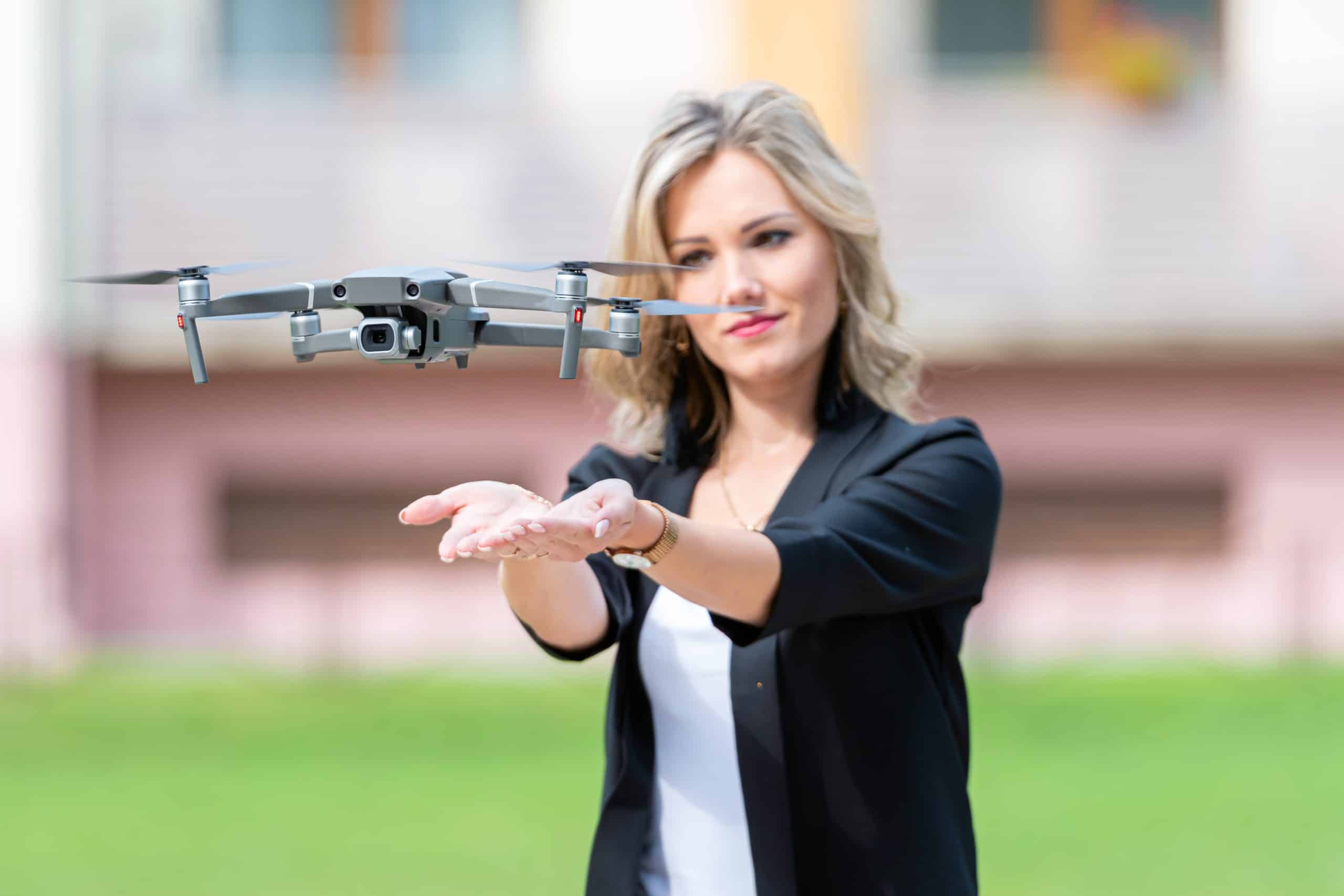
Let us separate two things first, because whoever searches for «drone filming» is usually one of two people and needs opposite answers.
If what you want is to hire aerial filming for your product, your hotel, your construction site or your campaign, you do not need to read this: what you are looking for is at UMILES Skycam, our aerial filming service.
If what you want is to make a living from it —to get paid for flying yourself—, read on. This article explains how the drone film market works in Spain, who really pays, what will be demanded of you on a shoot and what training separates the person who lands the job from the one who stays in an Instagram portfolio.
You are not competing with everyone who owns a drone
You are competing with those who can also work legally where the shooting happens, and there are far fewer of those. That is the difference training makes.
Índice de contenidos
ToggleThe problem with this specialisation, put plainly
Film work is the path with the most people competing, by a distance. It is the first one everyone thinks of, the apparent barrier to entry is low —a drone and good taste— and there are thousands of people with a showreel and no job.
But that saturation is more apparent than real, for one specific reason: most of those people cannot legally work in the places where shooting happens. A shoot in a city centre, with crew and extras on the ground, or a shot over an event with an audience, does not fit in the open category. The moment the production asks for insurance, documentation and authorisation, the pool of candidates shrinks to a fraction.
The practical consequence: you are not competing with everyone who owns a drone. You are competing with those who also have the paperwork, and there are far fewer of them.
Who pays, and why
Advertising and branded content
The highest rates and the most demanding days. The aerial shot goes into a locked-down shooting script, it has to be repeated until the director is happy and there is zero room for improvisation. You work under a production manager who expects you to speak their language: when you are ready, how long your battery lasts, how many takes are left.
Film and television
The ground where pure flying skill counts most, especially once FPV comes in. An immersive shot that goes through a window, follows a car or drops down a stairwell is not done by a drone in automatic mode: it is done by a trained pilot. It is the hardest skill to acquire on this list and therefore the one fewest people truly master. If you are not sure what we mean, start with what an FPV drone is.
Real estate and tourism
The volume. Lower rates per job, far more jobs, and a client who values fast delivery over virtuosity. It is the best place to start putting hours in and building a portfolio.
Events and sport
Weddings, competitions, concerts, outdoor races. Watch out for the legal detail: overflying crowds is heavily restricted, and a good number of the shots people picture here require specific category and a controlled ground area, not just good intentions.
Industry and corporate
Company video, construction progress, annual reports. The least glamorous client and the most loyal, because they need the same thing every quarter. The same job often overlaps with photogrammetry —they want the video and the measured progress—, and whoever can deliver both gets paid for both.
What they will demand on a shoot, and it is not pretty flying
This is where most people fall. A professional production does not hire you for your showreel: it hires you because you can fit into its shooting schedule without creating a problem. What they will ask you for:
- Aeronautical documentation in order: registration as a UAS operator, accredited pilot training and, depending on the scenario, an authorisation or operational declaration.
- Civil liability insurance with sufficient cover. The production has its own and will ask for yours, on paper.
- Location permits: council, film commission, private property, venue manager. The flight permit and the filming permit are different things and you need both.
- Aeronautical coordination when the location is in controlled airspace or near an aerodrome. It is what eats the most time.
- Delivering in the client’s format: agreed colour profile, codec, resolution and frame rate of the project. Handing over «the file from the card» marks you as an amateur.
That paperwork block is so decisive that there is specific training just for it, and in practice it is what decides whether a location can be shot at all.
And how to behave on a shoot
This is in no syllabus and it is what gets you called back. A film crew runs on a hierarchy and on timings that are not up for negotiation: you are one more department, not the star of the day.
- Arrive early. Set up, check the day’s airspace, go through batteries and be ready when they call you, not start preparing then.
- Give real timings. How long your battery lasts, how many minutes you need between takes, how many passes you have left. Production plans with those numbers.
- Mark out your area and say it out loud. Where you take off, where the drone comes in, who cannot be there. Safety on set is yours within your radius.
- Know how to say no. If the shot they are asking for is not legal or not safe in the wind there is, you say so beforehand, not afterwards. A pilot who says no and offers the alternative inspires more confidence than one who says yes to everything.
- Deliver the same day if asked. Backup made on set, not at home.
None of that is learned flying alone in a field, and it is exactly what separates a hireable pilot from one with a good showreel.
The 2026 legal change that affects you directly
If your work is going to include shooting in a populated environment with a controlled ground area —which is half of film work— you are in specific category. And there has been a change: since 1 January 2026, declarations under the national STS-ES scenarios are no longer valid. To keep operating under a standard scenario you have to declare under STS-01, with a C5 class drone, or STS-02, with C6 class, and the pilot needs the STS theoretical knowledge certificate from AESA.
Translated into your wallet: the aircraft you buy determines which jobs you can pitch for. It is worth deciding the type of work before the drone model, not the other way round.
FPV is the most requested and least covered skill
An immersive shot is not done by a drone in automatic mode. It is the hardest skill to acquire and the one that best sets you apart.
What training separates those who get paid from those who do not
The legal base. Open category first and the STS certificate afterwards. It is not bureaucracy: it is what qualifies you for the jobs that pay. It is covered in the professional drone pilot course and in the STS certifications course.
The film language. This is the real difference. Knowing what movement each shot calls for, how it cuts against the previous one, how to expose so it can be graded later, how to plan a day so the sun is where it needs to be. The drone is a crane that flies; what gets hired is the shot, not the flight. That is the content of the audiovisual drone operator course.
FPV, if you want the hard work. It is the specialisation most in demand and least covered, and the only one on this list you cannot learn by reading: it is learned on a simulator and with hours. It is in the FPV pilot course.
Basic post-production. Not to turn you into an editor, but so you can hand over something usable.
How you actually get in
The route that nearly always works is the same one, and it does not start with advertising.
It starts with real estate and tourism, where the entry bar is lower and the volume high, to build up real flying hours and learn to deliver on time. It carries on through corporate, where the client repeats and forces you to professionalise the administrative side. And from there you reach advertising and fiction, where the job comes through a recommendation from a production manager who has already seen you work.
The shortcut that does not work is the opposite: spending on the best kit, making a spectacular showreel and waiting for advertising to call. What opens doors is being able to produce documentation, insurance and permits the day they are asked for, and having delivered on time fifty times before.
If on top of that you can offer something the rest cannot —FPV, a survey, a roof inspection on the same visit—, you stop competing on price. That is the underlying argument of career paths for drone pilots: crossed specialisation is what holds the rate up.
And if you are still deciding whether film work is your thing or another branch fits you better, in which drone course you need depending on what you want to do all ten are compared. Once you are clear, tell us where you are coming from —whether you already edit, already fly, or start from scratch— and we will tell you which route is yours.
If you already edit or already fly, you are not starting from scratch
- ✓Training approved by AESA
- ✓Real flight practice, not just theory
- ✓In-person classes in Madrid
- ✓We tell you which route fits you, no strings attached
Would you rather we guided you first? Tell us your goal