Category: Sin categoría

  • Review of Solar Farms with Drones

    Review of Solar Farms with Drones

    As we have explained on other occasions, there are many uses for professional drones, and this trend of optimising processes using UAVs is rapidly spreading to different industries. Sustainable energy is one of them, so on this occasion we are going to explain the importance that has been gained by the drone review of solar farms, as a transformative practice to redefine efficiency in the management of solar farms.
    Innovation in solar farm maintenance with drones
    As is the case with drones in agriculture, these unmanned aircraft can be used to analyse solar farms in search of problems or faults. This process has been optimised through the use of different technological and computer resources, which have enabled exponential growth in the development of the energy industry.

    The advance of drone data collection

    Through the use of thermal cameras and geofencing, solar farms can be checked with drones to map large areas in a short time and detect if there is a fault in one or several panels. This avoids technicians having to make individual, face-to-face checks, speeding up decision-making to apply an immediate solution.

    Raptor Maps data interpretation and solutions

    With the efficiency in the collection of data from solar farms by drones, the need arises to use software tools that help to quickly process all the data recorded by the drones. In this sense, Raptor Maps has emerged, an advanced software that is positioned as a pioneer in the revolution of the solar industry.

    Raptor Maps’ revolution in the solar industry with drone technology

    Raptor Maps has deployed drones equipped with thermal cameras and machine learning software to optimise data collection and analysis. This advanced technology enables detailed inspection at individual cell levels, overcoming the limitations of conventional techniques.

    Thanks to its ability to process data efficiently, Raptor Maps has established itself as a global leader in the solar energy sector.

    Challenges and opportunities in the solar industry

    As the solar industry continues its ascent, significant challenges arise in the maintenance of solar farms. Raptor Maps has been a pioneer in identifying and turning these challenges into opportunities to improve efficiency and reduce costs. Detailed analysis of thermal images can diagnose electrical or mechanical problems, providing a clear view of the areas that require priority attention.

    The trajectory and evolution of Raptor Maps

    Raptor Maps’ trajectory is a story of adaptation and strategic growth. It was founded in 2015 by Eddie Obropta, Forrest Meyen and Nikhil Vadhavkar, initially as a drone company offering services to the agricultural industry, to analyse crops and gather information as they grew. Gradually, however, they realised that their software had other applications.

    When they released the software to the public in 2017, they found that most people were using it to analyse solar farms, which quickly made the founders realise that they needed to focus their efforts on the sustainable energy sector.

    In 2018, they decided that Raptor Maps would focus exclusively on solar energy and is now a leader in drone solar farm reviews, demonstrating a unique ability to anticipate and respond to changing market demands.

    Innovación en el Mantenimiento de Granjas Solares con Drones

    Adaptation and success in the solar market

    Raptor Maps’ ability to adapt to changing market needs has been essential to its success. By processing data on a global scale, the company has played a crucial role in making solar energy more efficient and attractive to investors, operators and solar farm owners.

    Today, many drone operators partner with Raptor Maps, and after collecting their data, they send the information to the system, which creates a detailed map of the solar farm, noting how many panels have a problem, detailing how energy production is affected and even making a fairly accurate estimate of how much it might cost to make the necessary repair.

    Thus, through its continuous innovation, Raptor Maps has demonstrated that the alliance between renewable energy and advanced technology is the key to a sustainable and efficient future in the solar industry.

    If you want to become a drone pilot and work in the solar industry, don’t forget that at UMILES University we have the best drone courses in Madrid.


  • The Transformation of the Mining Industry Driven by Drone Technology

    The Transformation of the Mining Industry Driven by Drone Technology

    During the last few years, drones have become indispensable tools in multiple fields of work. From agriculture to construction, these unmanned aerial vehicles carry out activities of great relevance that optimize all kinds of tasks. Recently, the mining industry has joined the primary uses of professional drones.

    In this article, we will detail everything related to the mining transformation by drones, which is redefining practices and opening up a range of possibilities that previously seemed unreachable.

    Impact of Drone Technology on Mining

    As mentioned earlier, the mining industry is undergoing a revolutionary transformation driven by drone technology. These unmanned aerial devices are not only changing the way operations are carried out but also fundamentally transforming efficiency and safety in the sector.

    From prospecting to operational surveillance, the integration of drones into the mining industry provides a unique and detailed perspective that enables more informed decision-making. The speed at which drones can collect topographical and geospatial data has accelerated mapping processes, reducing associated times and costs.

    Thanks to the use of multispectral cameras, drones have the ability to capture images beyond the visible range for the human eye. This allows for efficient inspection in mining exploration, with minimal resource utilization.

    Success Stories: Drones in Mining

    Numerous success stories support the effectiveness of drone technology in mining. Leading companies such as Newmont Mining and Caterpillar have implemented drone systems to enhance planning and operations supervision, optimizing their logistics processes.

    Through drone photogrammetry, the mining giant in the United States, Newmont Mining, has successfully conducted large-scale explorations and created precise 3D models of the topography, enabling the detection of mining opportunities that were previously overlooked.

    Meanwhile, Caterpillar has leveraged drone technology to streamline the logistics of its operations by efficiently tracking material volume without the need for manual supervision. This streamlines the production chain, positively influencing the demand for machinery in the mining sector.

    Benefits and Challenges of Drones in Mining

    The adoption of drones in mining brings a series of benefits, but also presents unique challenges. Among the benefits are increased operational efficiency, more effective asset management, and cost reduction. It is essential to highlight that one of the main benefits of drones in mining is the reduction of labor risks by eliminating the need for personnel to enter hazardous areas for exploration.

    Furthermore, for mapping large areas, there is no longer a need for helicopters or heavy vehicles, as drones can provide high-quality aerial photographs, reducing operational costs.

    However, the successful implementation of drone technology also faces challenges related to personnel training, cybersecurity, and regulation. Therefore, training pilots in specialized areas such as photogrammetry, topography with drones, technical inspections, and security is essential.

    At UMILES University, we offer the best drone courses in Madrid, with a wide range of training options and all the necessary certifications for you to work as a professional drone pilot.

    The Future of Mining with Drones

    The future of mining with drones looks exciting and full of possibilities. As technology continues to advance, even more innovative developments are expected, such as complete process automation, the integration of artificial intelligence for data analysis, and continuous improvement in flight autonomy.

    Currently, drones have become indispensable tools in various fields of work, and in the mining industry, a similar trend is likely to occur in a short time.

    Therefore, it can be said that this transformation of the mining industry with drones shapes a smarter, safer, and more sustainable future for all involved in the sector.

  • Complete Guide to Registration for the AESA A1/A3 Drone Pilot Course and Examination

    Complete Guide to Registration for the AESA A1/A3 Drone Pilot Course and Examination

    If you want to work as a drone pilot, or simply want to operate your drone in the A1/A3 subcategories, it is necessary that you take the online training pass test that enables you to fly without complications. For this reason, we have prepared a step-by-step guide for the A1/A3 Drones Course and Examination, which will allow you to know in detail each of the aspects to consider before taking the test.

    Introduction to the A1/A3 drone pilot course and test

    To take the A1/A3 drone pilot certificate, you must be prepared to pass a free test that is conducted through the AESA portal. The preparation required before the test, as stipulated on the EASA website, is limited to reading the syllabus available on the website. No additional training through an ATO is required for this stage of the process.

    Approved Training Organisations (ATOs) offer specialised courses for different types of drone certificates. However, to obtain the Open Category A1/A3 pilot certificate, it is not necessary to have completed previous approved training at an ATO. This information is crucial for those seeking to acquire the A1/A3 Open Category drone pilot certificate.

    Introducción al Curso y Examen de Piloto de Drones A1/A3

    Detailed Procedure for Registering for the AESA A1/A3 Examination

    Before proceeding to register for the A1/A3 examination, it is essential that you have your digital certificate installed in your web browser so that you can sign the application after completing the form.Top of Form

    1. Access to the Registration Process

    Once you have your documentation prepared, you’ll need to access the following link for registration in the A1/A3 course:

    https://sede.seguridadaerea.gob.es/sede-aesa/catalogo-de-procedimientos/curso-de-formaci%C3%B3n-y-examen-de-piloto-distancia-en-categor%C3%ADa-abierta

    1. Navigation on the AESA website

    Once you’ve accessed the registration link, you should click on the “Online procedure” button. This will direct you to the identification screen, where you’ll need to select the appropriate method based on your particular case:

    • Cl@ve System: for identification using a digital certificate or electronic ID, PIN codes, permanent password, and EU citizens.
    • e4F System: ideal for foreigners who cannot access through the Cl@ve System (registration is required in this case).

    If you choose the Cl@ve System, you’ll have various options for identification. However, it’s highly recommended to log in using the digital certificate, as the other methods do not allow for digital signature generation.Top of Form

    1. Filling out the Registration Form for the A1/A3 Examination

    Top of Form

    • If you have logged in with an Electronic Certificate, the system will automatically populate the fields with the personal information registered in that document. You only need to complete the fields that are blank, such as email, landline, and mobile phone number. Press the “Next” button once you have filled out all the fields.
    • On the next screen, you will need to enter the relevant documentation if the application is made by representation. If this does not apply to your case, simply press the “Next” button.
    • On the third tab, you will find the Data Protection clause, where you must tick the option to consent to the processing of personal data for the purpose of “Distance pilot training management”. Press “Next”.
    • Finally, you will access the tab for signing and registering the application. Verify that all the information you have entered is correct and proceed to press the “Submit application” button.
    • Next, you will see the available signature options: Autofirma or Clavefirma. Choose the option that best suits you and press “Sign”.
    • Once the registration process for the A1/A3 examination is complete, the presentation receipt will be generated, which you can download as proof.

    Navegación en la Web de AESA

    Special Cases: Minors and Representation

    Top of Form

    In case the application is made by a minor under 14 years old or a person acting on behalf of another, you should check the box “Mark this option if acting as a representative” in the “Applicant Data” tab.

    Next, in the “Incorporated Documentation” tab, you should upload the documents that validate the representation (Appointment of Representative, Authorization from parents or legal guardians for minors under 14 years old, or other relevant documentation).

    The remaining steps should be completed in the same manner as explained previously.

    Accessing and Reviewing the Status of Applications

    Top of Form

    To view your active requests, simply navigate to the homepage of the procedure. You can review the status of your application by clicking on the “My Requests” tab. There, you will see the date the application was submitted and its current status.

    Remember that you have 30 business days to submit the test. After this time, it will be considered that there has been withdrawal.

    So, if you haven’t prepared for the A1/A3 drone pilot test yet, we invite you to join UMILES University, where we offer the Best Drone Courses in Madrid to help you easily pass the exam.

    Top of Form

  • Top 5 Best Mini Drones with Camera for 2024!

    Top 5 Best Mini Drones with Camera for 2024!

    Advances in drone technology are so impressive that it is now possible to find a wide variety of mini drones on the market with cameras that offer impressive results despite their compact size.

    In this article we have compiled a list of the 5 best mini drones of 2024, which have excellent camera quality, great performance, professional features and advanced technology systems. This way you can find the perfect mini drone with camera for your adventures or projects and take it with you wherever you go.

    Top 5: The best small mini drones with camera

    In this list we will mention options such as the DJI Mini 3 PRO or the Autel EVO Nano +, which are quite popular alternatives. Discover the differences between these types of drones and choose the option that best suits your needs.

    Remember that UMILES University offers the best drone courses in Madrid, so you can specialise and work as a professional drone pilot anywhere in Europe. In addition, we offer you the specialisation in filming through our drone operator course in audiovisual.

    DJI MINI 3 PRO

    The DJI Mini 3 PRO is not just a nano drone, it’s a miniature technological wonder, which weighs no more than 249 grams. But don’t let its size fool you, it has some excellent features.

    Its powerful battery offers up to 34 minutes of flight time and thanks to its DJI O3 system, you can stream HD video over distances of up to 12km. Plus, its 4x zoom camera lets you capture stunning images without getting too close to the object of interest.

    minidrones

    DJI MINI 4 PRO

    This model is essentially the successor to the Mini 3, which raises the standard for compact drones. Its foldable and ultra-lightweight design, weighing less than 249 grams, makes it the ideal travel companion.

    But what really makes this “micro drone” stand out is its ability to shoot aerial footage in 4K HDR quality, capturing vivid colours and sharp detail. Plus, with its smart battery, you can enjoy up to 34 minutes of uninterrupted flight time allowing you to explore and capture for longer.

    micro drone

    Autel EVO Nano +

    The Autel EVO Nano + is one of the minidrones that combine sleek design and power. Its features include a flight time of up to 28 minutes, allowing you to capture moments from the air over an extended period of time.

    Among the most notable drone parts of the AUtel Evo Nano+ is its 48 MP camera, which is capable of 4K drone filming at 30fps, guaranteeing high-resolution images and videos. When combined with its 3-axis gimbal, it ensures smooth and stable recordings, even in unfavourable wind conditions. In addition, it features an advanced obstacle detection and avoidance system, so your flights will be safer than ever.


    smallest drone

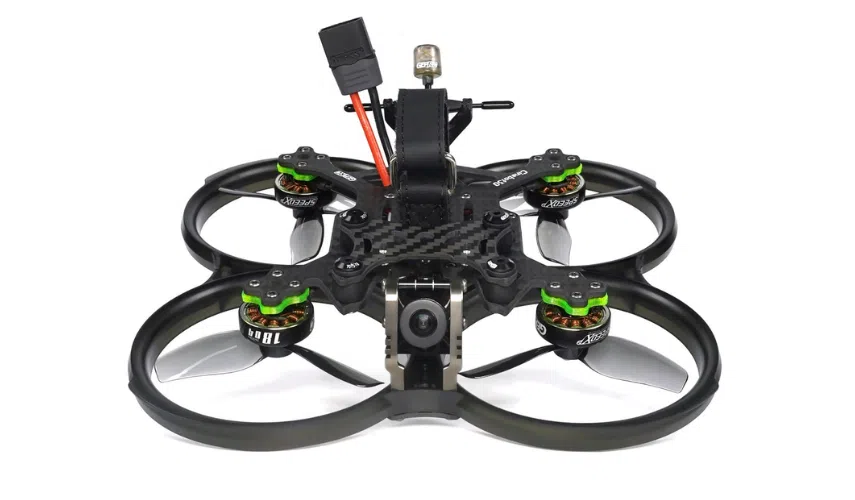
    GEPRC Cinebot30 HD O3

    This is GEPRC’s smallest drone and is a filmmaker’s dream, as it is designed with high-strength aluminium parts and a shock-absorbing pad to meet any challenge.

    Among its features is an O3 AIR Unit transmission system, which allows you to view real-time 1080P images at 60fps, while recording in 4K at 60fps. In addition, its compatibility with full-size GP cameras and optimised engine make it ideal for low altitude filming.

    nano drone

    Defender 25 4S HD

    For those looking for an immersive experience in any kind of space, the Defender 25 4S HD FPV drone is the perfect choice. This small camera drone, designed to fly both outdoors and indoors, comes equipped with a 4K camera that records stunning videos in a fully stabilised manner.

    This makes it a very versatile choice for all kinds of filming, making it one of the most outstanding and convenient small real estate drones.

    mini drones

    How long does a mini drone battery last?

    Drone batteries can have a variable battery life depending on a number of factors. In the case of mini drones, an average flight time of 28 minutes can be established. Although there are options such as the DJI Mini 3 PRO that can stay in the air for 34 minutes uninterrupted.

    What is the range of a small drone?

    The range of a mini drone with a camera can vary, but some models offer up to 10km of transmission, while others are designed for shorter distances, such as 1000 metres.

    We hope that among this list you have been able to find the best mini drone for 2024, and don’t forget that you can contact us for training through our professional drone pilot course with all the necessary certifications.

  • All about Drone Categories: Open, Specific and Certified

    All about Drone Categories: Open, Specific and Certified

    The operational categories were modified at the end of 2020, since then they were divided into three main groups which are called open, specific and certified. It is just for this reason that in this article we have compiled the most advanced information about the drone categories, so that you are informed of all the changes and do not fail to comply with the current AESA drone regulations due to lack of knowledge.

    How many and which are the drone categories?

    As previously explained, drone categories are divided into 3 main groups (open, specific and certified). However, the open category is further segmented into 3 additional subdivisions known as “Drone Category A1 A3”, which group the most common types of drones used for both professional and recreational use.

    category certified drones

    Open Category

    The open category includes all low-risk drone operations conducted at a maximum height above ground of 120 m (658 ft). Generally, in the open drone category, no authorization from AESA is required to conduct a drone flight. However, in some cases it will be necessary to pass the AESA A1/A3 drone exam to certify that the pilot is qualified to perform the operation.

    This classification is divided into three subcategories (Al, A2 and A3), each with its own restrictions and operational requirements. Depending on the type of drone, the pilot must apply for the A1 A3 drone license.

    Subcategory A1

    Operations in subcategory A1 are not allowed to fly over concentrations of people and must avoid overflying anyone not participating in the operation. Operations in this category must be conducted with aircraft with identification tags C0 or C1. This means that operations are low risk, but precautions must still be taken to avoid possible incidents.

    Subcategory A2

    Operations in subcategory A2, or A2 drone category, shall be conducted maintaining a safety distance of at least 30 m from individuals in the vicinity of the operation. This distance may be less if the aircraft incorporates the low speed mode.

    This type of operations can only be performed with C2 class drones. This implies that operations may be slightly riskier than those in subcategory A1, but certain restrictions must still be followed to ensure safety.

    Subcategory A3

    Operations in subcategory A3 must be conducted in areas where no persons are endangered and at a minimum horizontal distance of 150 m from residential, commercial, industrial or recreational areas.

    In addition, aircraft must have a maximum take-off mass (MTOW) of less than 25 kg or have a class C2, C3 or C4 rating. This subcategory is the most restrictive of the three, but allows operations with larger drones.

    open category drones

    Specific Category

    The specific drone category includes all medium risk drone operations. Within this category, two standard scenarios have been defined for which no authorization from AESA is required, a responsible statement from the operator would be sufficient.

    These scenarios are designed for operations within the visual range of the drone pilot (VLOS flights) and outside the visual range of the drone pilot (BVLOS flights), respectively.

    Certified Category

    The certified drone category encompasses all high-risk drone operations conducted with aircraft with dimensions of 3 m or more. It also includes operations over concentrations of people, such as those performed with cargo drones for the transport of people or dangerous goods, or other operations considered high risk by AESA.

    All operations performed within this category require certified drones, drone pilots have the necessary license and the operator has the certificate issued by AESA.

    In UMILES we give you the opportunity to get certified through our UAS/drone pilot training in open, specific and certified category. Check how to obtain the drone license and join our professional drone pilot course so you can get certified and operate in any of these categories.

    training of uas drones pilots in the open category

    Which drones can you fly with A1 and A3?

    Drones that meet the characteristics of subcategories C0, C1 and C2 of the open category are included in levels A1 and A3. These levels define the limits of the minimum distance drones must be kept from people and buildings.

    • A1: Drones falling into subcategory C0 can fly at a minimum distance of 30 meters from people and 50 meters from buildings.
    • A3: Drones that fall into subcategories C1 and C2 must maintain a minimum distance of 150 meters from people and 150 meters from buildings if the drone weighs more than 2 kg, or 50 meters if it weighs less than 2 kg.

    Which drones can fly with A2?

    The A2 category applies to drones that comply with the regulations established for the open category and have additional safety systems. Drones weighing more than 500 grams and up to 2 kg can fly in category A2 and must maintain a minimum distance of 30 meters from people and 50 meters from buildings.

  • Can you fly drones in Madrid? 5 TOP 2023 sites!

    Can you fly drones in Madrid? 5 TOP 2023 sites!

    At UMILES we understand how challenging it can be to find unrestricted places to enjoy your recreational or professional flights. Therefore, we provide you a list of 5 top places where you can fly drones in Madrid.
    However, it is important to note that before each flight you should check the information on the ENAIRE Drones application, as there may be events that may modify the restrictions without prior notification.

    How to fly a drone in Madrid?

    The first thing you should do is check whether you need a licence to fly drones in Madrid. Remember that different requirements apply to different types of drones. In case your drone needs a licence, you can obtain it through our drone pilot course in Madrid, which is among the best drone courses in Spain. This is important, because if you don’t comply with this requirement you can expose yourself to fines. So you should check how much the fine is for flying a drone without a licence.
    The next thing to do is to check which are the areas where you are allowed to fly drones in Madrid without restrictions.

    Where can you fly a drone in Madrid?

    If you want to enjoy an incredible flight practice, we recommend you to visit one of the 5 top places below, so you can fly your drone in Madrid without going too far.

    Balcón del Tajo

    The Balcón del Tajo, located southeast of Madrid near the border with Castilla La Mancha, offers breathtaking views from above, making it the perfect place to take off your drone. Enjoy unparalleled panoramic views and capture unique moments in this beautiful spot. Here, in principle (remember to check before flying your drone), there are no restrictions on drone flying, allowing you to explore the sky with complete freedom.

    The sparsely populated area makes it easy for you to fly legally without disturbing anyone. If you’re looking for the best shots, winter is ideal for flying over the snowy surface and capturing magical lights at sunrise.

    fly a drone in madrid

    Before each flight, it is essential to check the current restrictions on drones.enaire.es as these can change daily. Do not forget to comply with current legislation. UMILES Group assumes no responsibility for improper use of this information.

    Villamanrique de Tajo

    It is a charming village on the banks of the Tagus River, which offers wide open spaces and a natural environment to appreciate the beauty of the surroundings and make stunning recordings with drones.

    Keep in mind that castles are ideal for maintaining a direct connection with your drone. So in this area you can take advantage of the attraction of Alboer Castle as a take-off and landing point. Also explore the Villamanrique del Tajo river park and its hiking trails to capture stunning images.

    where can you fly a drone in madrid

    Before each flight, it is essential to check the current restrictions on drones.enaire.es as these can change daily. Do not forget to comply with current legislation. UMILES Group assumes no responsibility for improper use of this information.

    Pozuelo del Rey

    Near Nuevo Baztan is Pozuelo del Rey, a charming village in Madrid with rich history and large green areas where you can fly drones. This charming town offers a combination of historical richness and ample green areas to capture the essence of Pozuelo del Rey from the sky.

    With almost 1000 years of history, this small town offers a perfect setting to fly your drone in Madrid and capture its essence from the sky without disturbing anyone and without the risk of incurring penalties.

    Where can I fly a drone under 250 grams in Madrid?

    Before each flight, it is essential to check the current restrictions on drones.enaire.es as these can change daily. Do not forget to comply with current legislation. UMILES Group assumes no responsibility for improper use of this information.

    Robledo de Chavela

    The Sierra de Madrid (Madrid Mountain Range) is the perfect scenery to obtain the best aerial videos of the whole Community. This is due to its geological formations and views from the plateau that are truly impressive from the air. If you go to this area, you cannot miss Robledo de Chavela, which awaits you with picturesque landscapes and a peaceful atmosphere that will offer you a relaxing and enriching flying experience.

    Although this is one of the areas where you can fly drones in Madrid, it is essential to check for possible restrictions nearby, such as those associated with military activities or nearby airfields. So before flying, draw imaginary boundaries to avoid invading restricted areas. For example, use visible elements in space, such as windmills, houses, mountains or rivers, to know where you should not overshoot.

    where to fly drones madrid

    Before each flight, it is essential to check the current restrictions on drones.enaire.es as these can change daily. Do not forget to comply with current legislation. UMILES Group assumes no responsibility for improper use of this information.

    Prádena del Rincón

    The mountains of Madrid offer you many possibilities, and we recommend you to fly in the Laguna del Salmoral in Prádena del Rincón, which offers you an incomparable experience of flying with your drone, surrounded by nature and serenity. Its natural areas and idyllic landscapes will captivate your senses in every flight. At sunrise, you will get breathtaking images that will captivate you completely.

    drone pilot course in madrid

    Before each flight, it is essential to check the current restrictions on drones.enaire.es as these can change daily. Do not forget to comply with current legislation. UMILES Group assumes no responsibility for improper use of this information.

    Where can I fly a drone under 250 grams in Madrid?

    All the areas we have previously mentioned are ideal for flying drones of these characteristics. Although they are also perfect for other larger drones. If you are interested in a light and easy to carry UAV, you can not miss our list of the best drones under 250 grams and the best drones with follow me function.

    Keep in mind that the main restricted areas are usually airports. So we invite you to know everything about drones in airports and nearby areas, to avoid breaching the drone regulations in Spain.

    Now that you know where to fly drones Madrid, you just have to prepare your equipment and go out to enjoy the scenery making some excellent aerial photographs with drones.

  • What are the requirements to become a drone pilot?

    What are the requirements to become a drone pilot?

    Drones are increasingly required to perform different types of activities, so it is necessary to have a large number of qualified people to develop this profession. Working as a drone pilot is becoming one of the new growing careers, so many people have been interested to know what are the requirements to become a drone pilot, and what restrictions there are about it.

    Stay with us and read this complete article to find out how to become a drone pilot according to the current EASA regulations, so you can join the complete professional drone pilot course that we offer at UMILES University.

    If you are interested in finding out how to become a drone pilot in Spain, it is essential that you know the requirements established in the local regulations. According to Royal Decree 1036/2017 by which the civil use of remotely piloted aircraft is regulated, the requirements to be a drone pilot in Spain are as follows:

    • Be over 18 years of age.
    • Have current medical insurance, issued by an aeronautical medical centre or, failing that, by an authorised aeromedical examiner.
    • Have the necessary theoretical knowledge to fly drones according to the type and category in which the aircraft is classified.
    • Have a certificate accrediting your theoretical and practical training in the professional piloting of drones, through an ATO specialised in drone flight approved by the AESA (State Aviation Safety Agency). This document will be the equivalent of a drone licence, which will allow you to carry out this activity professionally.
    • In the event that you need to fly drones in controlled airspace, you will also need to be certified as a professional radio operator.

    This last requirement can be obtained by taking our drone radio operator course, which we offer at UMILES University.

    What do you need to fly a drone recreationally?

    Most of the requirements described above refer to the professional use of drones, however, in case you want to fly your drone recreationally, it will not be necessary to have the corresponding certification for the type of flight to be performed. Nor is it necessary to have a drone licence. What you do need is to be familiar with the manufacturer’s instructions for use.

    In addition, it is advisable to have drone insurance that covers at least third party damages in case of an accident. It is also important that you are aware of the places where you can fly drones without breaching the distance and maximum height requirements for this type of aircraft.

    Requirements to become a drone pilot in Spain

    In the ENAIRE Drones app you can obtain all the aeronautical information you need to operate your drone safely.

    What do you have to study to become a drone pilot?

    One of the requirements to become a drone pilot is to have the right training. But not just any training from any school you find on the internet will do.

    If you want to study to become a drone pilot, you need to look for one of the Approved Training Organisations, or ATOs, that offer specialised courses for drone operators. These are the agencies authorised by the EASA where you can study to become a drone pilot professionally and with all the necessary certifications to operate in different environments.

    What do you have to study to become a drone pilot?

    How long does a drone course last?

    Generalmente este tipo de estudios tiene una duración de varios meses o incluso de un año, según sea el tipo de agencia que ofrezca la formación.

    Generally, this type of study lasts several months or even a year, depending on the type of agency offering the training.

    In the case of UMILES University, we offer the most complete course on the market today, with 3 training modules that include 200 hours of flight certifications, 296 hours for professional specialisations and 40 hours of flight in real operation so that you can put into practice all the knowledge acquired in the first modules.

    What do you have to study to make drones?

    If you want to specialise in drone assembly, we recommend our specialised course in advanced drone mechanics, where you will learn about the assembly, repair and maintenance of this type of aircraft, which will allow you to access more job offers and thus improve the average salary of a pilot.

  • The 5 best drones under 250 grams in 2023

    The 5 best drones under 250 grams in 2023

    If you are interested in getting into the exciting world of drones and you are looking for portable, versatile and powerful options, you have come to the right place, as we will give you in this article a complete guide about the 5 best drones under 250 grams in 2023. And remember that if you want to become a professional pilot, you can find out about our official AESA drone pilot course, which contains more than 500 hours of training and several specialisations to be able to work as a professional drone pilot in various fields.

    The best drones under 250 grams

    Drones under 250g are usually quite attractive options, as they are classified as Class C0 drones, which are the simplest types of drones. Therefore, as we discussed in the article on the requirements to become a drone pilot, they are easy to use. They are often referred to as unlicensed drones, as the requirements for their use are quite simple.

    Here is a list of the best 250-gram drones with a high-resolution camera, portable and functional for different activities.

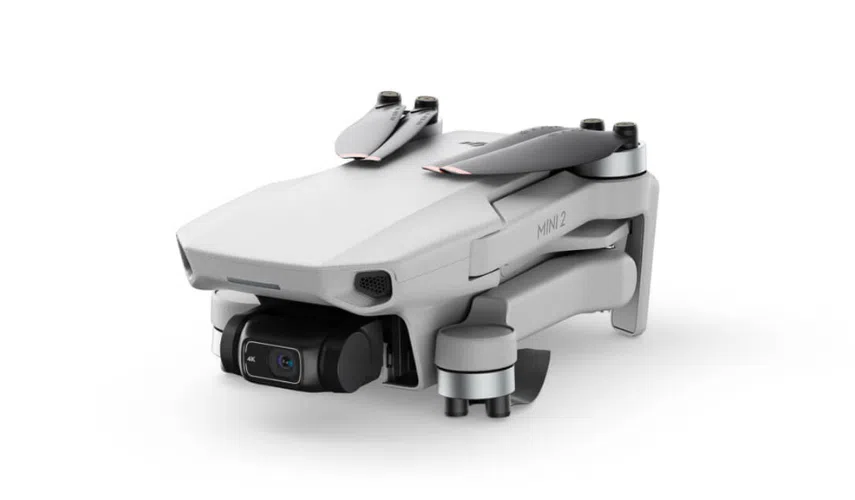
    Mavic Mini 2: Design and Power in a Compact Size

    The Mavic Mini 2, manufactured by the renowned DJI, is considered by many users to be the best drone under 250 grams for its excellent balance between portability and performance. This little prodigy weighs just 249 grams, allowing it to fly very lightly. It has a high-quality camera that captures stable images and videos in 4K resolution (3840 × 2160 at 24/25/30 fps).

    In addition, its flight autonomy has been improved, allowing up to 30 minutes of time in the air, thanks to its 5200 mAh battery capacity. Undoubtedly, it is an ideal choice for those looking for an unrivalled flight experience.

    Mavic Mini 2

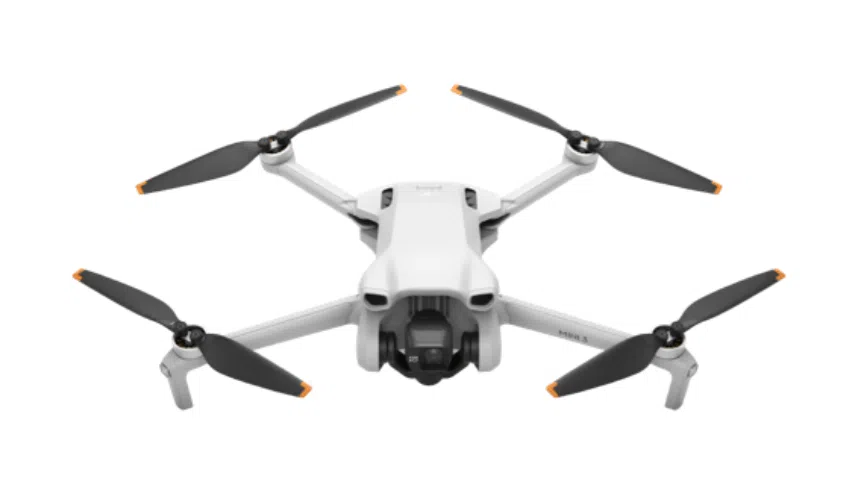
    Mavic Mini 3: The New Generation of Compact Drones

    The Mavic Mini 3, the successor to the already popular Mavic Mini 2, has arrived with even more improvements and innovative features, which is notable for weighing less than 249 grams.

    This drone is an excellent choice for aerial photography and professional drone filming enthusiasts, as it features a camera that can record in 4K (3840 × 2160 at 24/25/30 fps).

    In addition, the incorporation of obstacle avoidance technology ensures a safer and more comfortable flight, while the maximum flight time can be increased to 51 minutes when using the Intelligent Flight Battery Plus. This has also positioned it as one of the best drones with Follow Me function.

    Mavic Mini 3

    Autel Nano +: Miniature Power and Performance

    The Autel Nano+ is a technological gem among drones under 250 grams. With a foldable and compact structure, it is easy to transport and carry anywhere, weighing no more than 249 grams. It is equipped with a 48 MP camera, which allows it to record ultra-sharp videos at 4K/30fps.

    It has a state-of-the-art stabilisation system which ensures sharp images and smooth videos. In addition, it has several intelligent flight functions, making it suitable for both beginners and more experienced users.

    Autel Nano +

    GEPRC Cinebot 30 HD: A Cinematic Experience in the Sky

    If aerial cinematography is your passion, the GEPRC Cinebot 30 HD is the perfect choice for you. This ultra-lightweight drone weighing less than 250 grams features a powerful HD camera that allows you to capture high-quality footage from stunning angles. In addition, it transmits video with high-definition anti-vibration 4K 60fps ultra-high-resolution video quality.

    Its rugged and durable design makes it the best drone under 250 grams for indoor and outdoor flights, offering a unique cinematic flying experience.

    Remember that you can join our Drone Pilot course in Audiovisual, and specialise in this highly competitive area.

    GEPRC Cinebot 30 HD

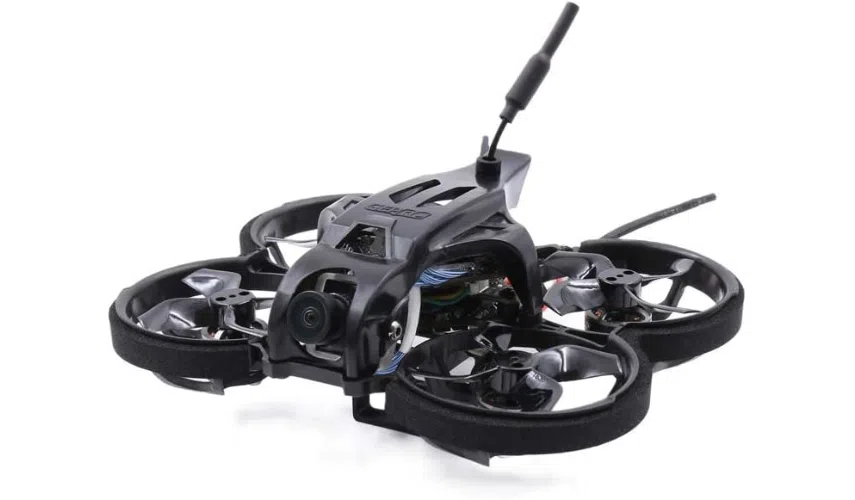
    GEPRC Tiny 4K Whoop: Fun and Excitement in Small Formats

    The GEPRC Tiny 4K Whoop is a drone designed for those looking for fun and excitement in indoor flying. With its compact size and a weight of only 150 grams, it is capable of flying in tight spaces and offers an agile and entertaining piloting experience.

    Despite its small size, this drone features a Loris 4K camera that allows you to record impressive videos while performing acrobatic manoeuvres. It also features high quality 800 * 480px FPV goggles, and a sensitive 5.8G receiver. So if you’re looking for a lightweight and affordable FPV drone, the GEPRC Tiny 4K Whoop is an ideal choice.

    GEPRC Tiny 4K Whoop

    What does it take to fly a drone under 250g?

    Before flying a drone under 250 grams, it is essential to know what the requirements and demands of the current AESA drone regulations in Spain are. Although these small devices do not require a drone licence, it is necessary to comply with some basic requirements to ensure safe flights and respect for the regulations.

    • Know the regulations: Although drone operator registration is not mandatory if the UAV is less than 250 grams, you need to know the local laws and regulations that affect drone flying, especially in public places and restricted areas. You should therefore learn the maximum height and distance a drone can fly, and familiarise yourself with the drone manufacturer’s manual.
    • Permitted flight zones: Research and know the areas designated for drone flight, avoiding areas near airports, military bases and populated areas. In our specialised article we tell you all about flying drones in SPA areas.
    • Drone maintenance: Make sure you keep your drone in optimal conditions, following the manufacturer’s instructions and carrying out regular checks. Remember that at UMILES you can prepare yourself in this aspect with our drone assembly, repair and maintenance course.
    • Weather conditions: Avoid flying your drone in adverse weather conditions, such as strong winds or heavy rain. You can consult the ENAIRE Drones application for more details on the limitations of drone flight in Spain.

    Where can you fly a drone weighing 249 grams?

    The advantage of drones under 250 grams is that they generally have fewer flight restrictions compared to larger and heavier models. However, it is essential to follow the regulations for drones weighing less than 250 grams, as the privacy and safety of other people must be respected.

    In any case, you can fly a drone under 250 grams as long as you follow the following guidelines:

    • Respect the maximum height and distance allowed, which is 120 metres high, and no more than 500 metres away from the pilot’s observation point.
    • Keep your eyes on the drone at all times, unless the pilot has the follow me function activated, or if you have an assistant observer at an intermediate point (EVLOS flights).

    You can find more details on where to fly drones in our blog article, or on the ENAIRE drones map.