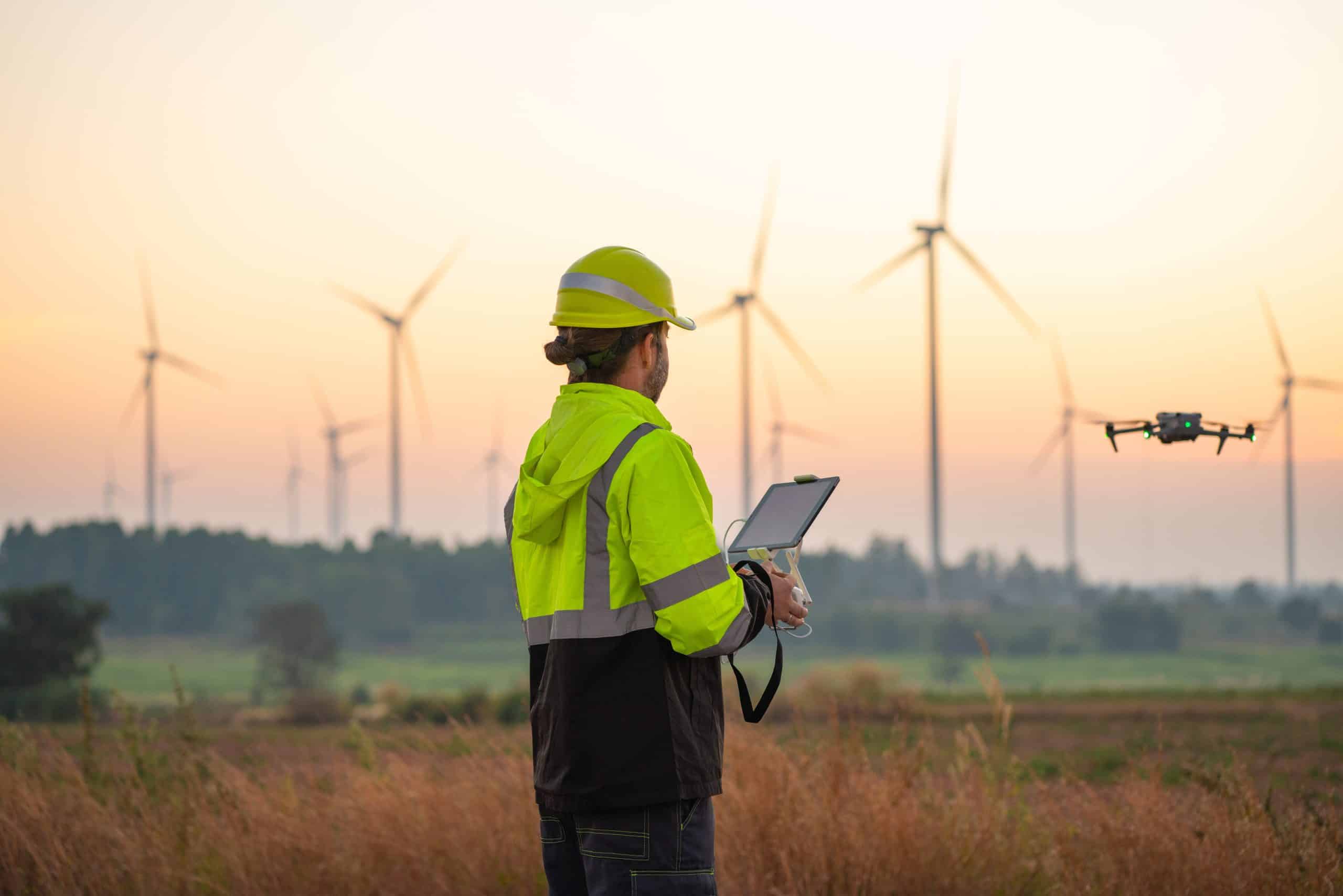
The question almost everyone asks before getting certified is not where to fly, but who is going to pay them to fly. It is the right question. Career paths for drone pilots in Spain stopped being limited to weddings and corporate videos a long time ago: today there is recurring work in agriculture, industrial inspection, surveying, security and aerial shows.
At UMILES we see both sides of the same business. We train pilots at UMILES University, our Madrid-based school approved by AESA (the Spanish Aviation Safety Agency), and at the same time we fly drones every day on drone light shows, photogrammetry and inspection work. We know which profiles companies are asking for because we hire them too.
Here are the sectors pulling hardest right now, the training each one demands and the working model you enter through: freelance, payroll or specialist team.
Pick the sector before the course
Every route on this list needs a different specialisation. Tell us which one interests you and we will tell you what it takes.
Índice de contenidos
ToggleWhat career paths a drone pilot has today
The underlying change came with the European UAS (unmanned aircraft systems) regulation. By setting out who can fly, with what equipment and in which scenarios, it turned the drone into a certifiable work tool for sectors that had never considered it. A power company does not hire someone with a drone; it hires an operator with a qualification, insurance and the ability to deliver a report.
That professionalisation is what opened up the job market. It is also why the pilot certificate on its own no longer sets anyone apart: it is the entry ticket, not the career. What makes the difference is the technical layer you build on top of it.
The sectors hiring the most pilots
Precision agriculture
Spanish farming is bringing in drones for crop spraying, crop monitoring and soil analysis with multispectral sensors. It is one of the fastest-growing niches because it solves a problem with money attached: using less product and spotting a pest or water stress before it is visible to the naked eye.
Be aware that flying is the easy part here. What gets paid is knowing how to read vegetation indices and prepare a prescription the agronomist can actually use. The route is the precision agriculture with drones course.
Technical and industrial inspection
Power pylons, solar farms, chimneys, roofs, façades, wind turbines. Any structure that is expensive or dangerous to check on foot is a candidate for drone inspection. Engineering and maintenance firms are looking for pilots who deliver a technical report, not a folder of nice photos.
It is one of the paths with the best medium-term prospects, because knowledge of the asset (thermography in solar, typical defects in concrete, criticality criteria) accumulates and gets paid for. It is covered in the technical drone inspection course.
Surveying and photogrammetry
Civil works, construction, mining and quarry management have spent years replacing part of the classic survey with photogrammetric flights. More ground is covered in less time and the crew is kept out of awkward areas. The pilot has to handle point clouds, orthophotos, digital terrain models and flight planning with enough overlap.
Demand is B2B and fairly stable, barely seasonal, and it usually comes with projects that repeat every month for the length of the job. If you want to see how it works from the inside, we have two articles with real cases: drone surveying and drone photogrammetry. The training is the photogrammetry and surveying course.
Film, TV and drone shows
The audiovisual sector still needs pilots for filming, advertising and events. It is the most accessible door and, for that very reason, the most crowded: plenty of people come in this way and compete on price.
The interesting branch now is a different one: drone light shows, with dozens or hundreds of drones flying synchronised choreography as an alternative to fireworks. The profile here is not an operator with a drone in a backpack, but a fleet technician: choreography software, preparing and charging batteries in series, safety checklists, coordination with the aviation authority and with the event client. High-value projects, concentrated around key dates in the calendar.
Security, emergency services and surveillance
Local police, fire services, civil protection and private security firms are adding drones for search and rescue, wildfire control, perimeter surveillance and accident support. It is the path with the heaviest regulatory demands: night flying, urban environments, restricted areas, real-time coordination with other services.
Before heading this way it pays to be clear on the operational framework. These two articles help: drone categories and flight scenarios and the updated drone regulations in Spain.
Fleet maintenance and operations
Not every career here means holding the controls. Anyone running large fleets (shows, agriculture, industrial services) needs people to assemble, repair, calibrate and maintain the equipment. Fine soldering, electronics, battery management, spare parts control.
It is a route that gets little publicity and has constant demand, especially for people coming from mechanics or electronics. To get an idea of the equipment you would be working with, take a look at the types of drones used in each application.
Where the demand is right now
Precision agriculture and technical inspections cannot find enough qualified pilots. Both are short, specific courses.
What the work pays, with every caveat
Any firm figure here would be a lie, because the range depends on the sector, the region and above all on whether you provide only the flight or the flight plus the deliverable. As an indicative market reference: a salaried pilot with no specialisation sits in low salary bands, close to those of a junior technician, while profiles with a technical speciality (thermographic inspection, surveying, agriculture) climb well above that.
The pattern that does hold: those who only fly are paid by flight hour; those who deliver processed data are paid by project. The gap between the two models is wide. That is why we insist so much on specialising.
What training each path needs
All these paths share the same base: an AESA-approved pilot certification. Without it there is no conversation with a serious client, because neither the insurance nor the operation stands up. That is the starting point of the professional drone pilot course.
From there, each sector adds its own layer: crop spraying in agriculture, data interpretation in inspection, photogrammetric software in surveying, coordination protocols in emergency work. The most common mistake we see is collecting unrelated courses with no plan. It works better the other way round: pick the sector, look at what real job ads in that sector ask for, and build the route towards it.
Freelance, payroll or team: how each sector works
In agriculture and surveying, the self-employed pilot with their own client base is common, often attached to a technical services company that passes work their way. In inspection, payroll weighs more, because maintenance is recurring and it suits the company to keep the profile in house.
In drone shows the model is different: it is teamwork. One person does not put on a show. Fleet, software, air safety, on-site setup and contact with the client on the day of the event all have to be coordinated. You come in as part of a specialist team, not as a lone freelancer.
Frequently asked questions
Which path has the most demand in Spain?
It depends on the profile. Precision agriculture and technical inspection stand out for volume and repeat work. Shows and audiovisual work move higher-value projects, but they are more concentrated in the calendar.
Do I need several courses or is one enough?
The base certification is compulsory in every case. Specialisation is optional on paper and decisive in practice: it is what separates you from the hundreds of certified pilots offering nothing but flight hours.
Can two paths be combined?
Yes, and it is common among freelancers. Surveying and industrial inspection fit well together because the client is similar. Audiovisual work and shows do too, adjusting the diary to the event season.
Which has the lowest barrier to entry?
Audiovisual, although it is also the most competitive and where prices are pushed down hardest. Agriculture and inspection demand more technical training from the start and make up for it with steadier work.
Is drone maintenance a real career even if it does not involve flying?
Absolutely. Any company with a fleet needs continuous maintenance, and it is one of the best ways into the sector if your background is technical rather than flying.
What age or previous education do you need to start?
No prior technical qualification is required for the pilot certification. A technical background does help a lot if you are aiming at inspection, surveying or maintenance, because it shortens the curve considerably.
What we see from the inside
We are not describing these sectors second hand. We train pilots who go on to work in agriculture, inspection or surveying, and at the same time we provide those same services with our own crews. That double position is what lets us say with some authority which paths have demand today and which sound better than they pay.
If you are sure you want to work in this but not sure which sector to start with, write to us. Tell us your situation from the contact page and we will point you in a direction based on your profile, your area and what companies are asking for right now.
Keep reading our blog
Turn the list into a career
- ✓Training approved by AESA, the Spanish aviation authority
- ✓Real flight practice, not just theory
- ✓In-person classes in Madrid
- ✓We tell you which path fits you, no strings attached
Not sure which path fits you? Tell us where you are and we will point you to the right one.