There is a question that reaches UMILES University every single week. It almost never arrives phrased this way, but it always means the same thing: «I want to work with drones, where do I start?». And there is a real problem behind it, because «drone course» is not one thing: it is a staircase with two separate flights and, on top of it, a dozen specialisations that have almost nothing in common with each other.
Someone who wants to carry out topographic surveys and someone who wants to shoot commercials need the same legal foundation and then completely different paths. Someone who wants to treat crops needs, on top of all that, paperwork that has nothing to do with aviation. And someone who just wants to fly at weekends probably does not need to pay for any course at all.
This article puts that staircase in order. First the compulsory part, which is the same for everyone. Then the specialisations, with what each one involves, who hires and what equipment you handle. The idea is that by the end you can point at a specific route instead of carrying on searching for «drone course» in the dark.
Do you already know what you want to do?
If you do, we will tell you in ten minutes what is compulsory in your case and what you can skip. And if you do not, we will help you decide.
Índice de contenidos
ToggleBefore choosing a specialisation: the two steps you cannot skip
The European framework —Implementing Regulation (EU) 2019/947 and Delegated Regulation (EU) 2019/945— splits drone operations into three categories according to risk, not according to the size of the aircraft:
- Open: low risk and no prior authorisation, with strict limits on height, weight and distance from people. It is divided into A1, A2 and A3.
- Specific: medium risk. It requires either declaring under a standard scenario or an authorisation from the aviation authority based on a risk assessment.
- Certified: high risk, with requirements comparable to manned aviation. Carrying people or dangerous goods.
Practically all the professional work that gets paid for in Spain lives in the specific category or at the top edge of the open one. And that is what defines the two steps.
Step 1: the open category (A1/A3 and A2)
A1/A3 training is free and you do it on your own: an online course and an exam on the AESA electronic portal. A2 requires passing an in-person exam at a recognised entity and declaring self-directed practical training. This lets you fly legally, but with limits that in practice rule out most serious jobs: you cannot approach uninvolved people beyond what your subcategory allows, nor fly over crowds, nor go beyond visual line of sight.
If what you want is to know exactly which subcategory your case falls into, it is set out in drone licence in Spain: which category you need. Here it is enough to keep one idea: the open category is the driving licence, not the trade.
Step 2: the specific category, and the January 2026 change
This is where genuinely paid work begins. The most common route, so that you do not have to build a full risk assessment, is to rely on a standard scenario and submit an operational declaration to AESA.
And there is a recent change here that many people have still not taken on board: since 1 January 2026, declarations under the national standard scenarios (STS-ES) are no longer valid. To keep operating under a standard scenario you have to declare under the European ones:
- STS-01: flight within visual line of sight (VLOS) over a controlled ground area in a populated environment, with a C5 class drone.
- STS-02: flight beyond visual line of sight (BVLOS) with observers, over a controlled area in a sparsely populated environment, with a C6 class drone.
To fly under either of them, the pilot needs the STS theoretical knowledge certificate issued by AESA after passing the official exam. That certificate is, in practice, the border between the hobbyist with paperwork and the professional who can be hired. At UMILES we cover it in the STS certifications course, and if you want to see the content before deciding anything, the STS-01 and STS-02 syllabus is published openly.
And one more thing: a pilot is not the same as an operator
This is the most repeated confusion and the one that causes the most trouble. The remote pilot is the person who flies. The UAS operator is the natural or legal person responsible for the operation, who must register with the authority and display their registration number on the aircraft. If you are going to invoice on your own account, you will be both, and they are two separate procedures. It is explained in differences between a drone pilot and a drone operator, and the registration itself in how to register as a UAS operator.
Add civil liability insurance, which is compulsory for professional use, and you have the minimum package.
The specialisations: eight different trades, not eight versions of the same one
From here on is where you decide what you are going to make a living from. These are the paths with real demand in Spain today, and what sets them apart.
Photogrammetry and surveying
Surveys, construction monitoring, volume calculations in quarries and mining, mapping. The drone is the sensor; the real work is in the processing and in delivering a point cloud or a model with certifiable accuracy. It is the most technical specialisation and also the one that most resembles stable employment, because engineering firms and construction companies hire it on continuous projects, not one-off jobs. The specific training is in the photogrammetry and surveying course.
Technical inspections
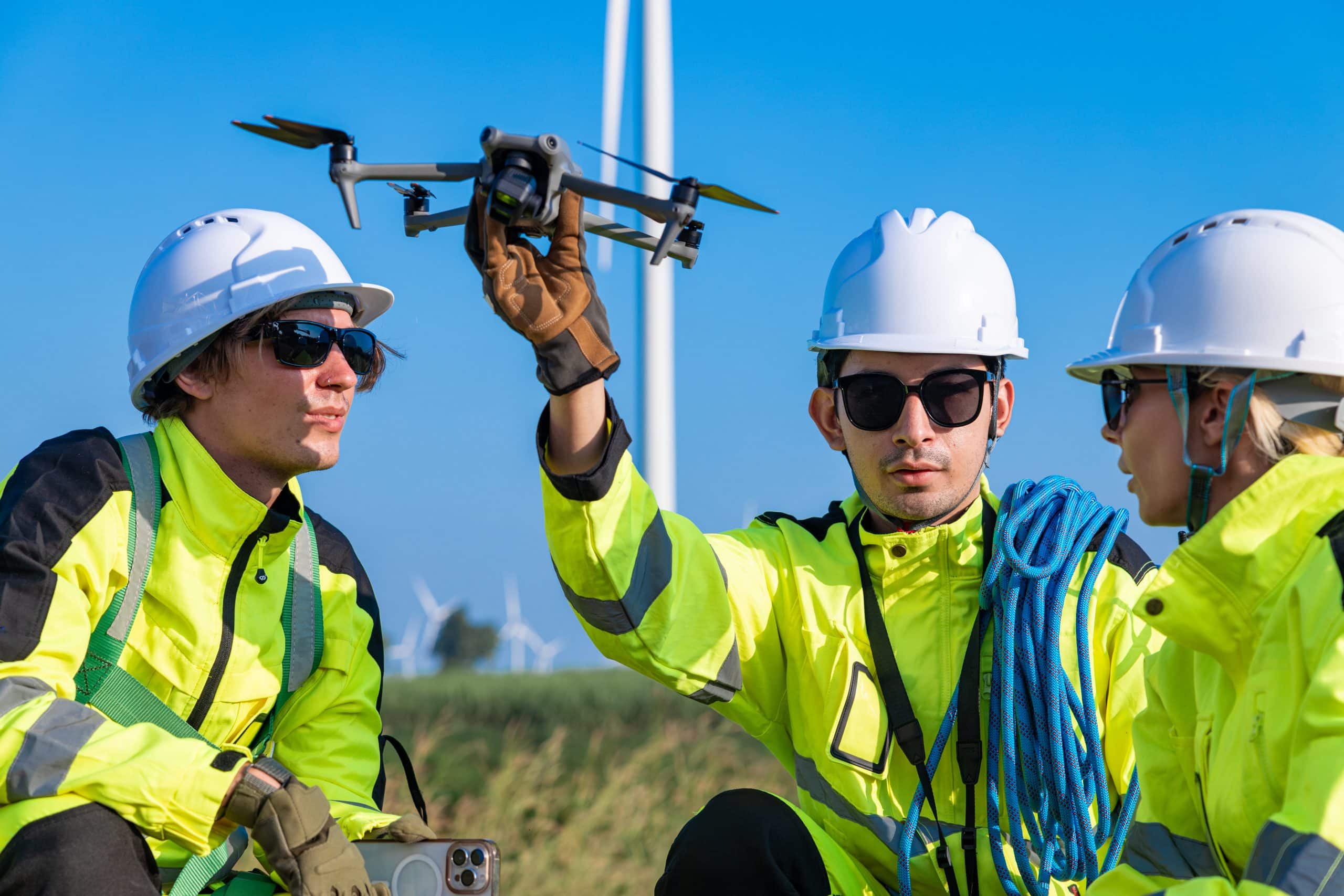
Wind turbines, solar farms, power lines, bridges, industrial roofs. You replace someone who used to climb up in a harness or hire a platform. Here the sensor rules: the thermal camera matters as much as the pilot. The clients are large —energy companies, infrastructure operators, industry— and they work with annual contracts. You prepare for it in the technical inspections course.
Precision agriculture
Vegetation indices with a multispectral camera, vigour maps, early detection of pests and water stress, sowing and treatments. Watch out for one important detail: the aerial application of plant protection products is regulated separately and the aeronautical side is not enough on its own. We cover it in detail in the article devoted to the rules on crop spraying with drones. The training foundation is in the precision agriculture course.
Film and broadcast
Cinema, advertising, television, real estate, tourism. It is the specialisation with the most people competing and also where the difference between knowing how to fly and knowing how to shoot shows most clearly: what gets hired is not the flight, it is the shot. It is covered in the audiovisual drone operator course.
FPV
Immersive flight with goggles, for shots that are impossible otherwise and for competition. It is the hardest skill to acquire and the one fewest people truly master, which makes it a serious differentiator within the audiovisual world. It is trained in the FPV pilot course, and if you are still not sure what it involves, start with what an FPV drone is.
Emergencies and security
Search and rescue, forest fires, civil protection support, perimeter surveillance. Operations where the drone arrives before anyone else and where the pressure is not technical, it is time. A good part of the demand comes from public administrations and private security firms. It is covered in the emergencies and security drone pilot course.
Assembly and maintenance
The specialisation nobody talks about and every fleet needs: repairing, calibrating, diagnosing, building custom equipment. You do not need to be the best pilot to make a living from this. It is in the drone assembly and maintenance course.
UAS permit management
This is the least obvious specialisation and probably the most profitable per hour. Processing authorisations, coordinating with air navigation services, preparing the documentation for an operation in controlled airspace. Almost every operator has its bottleneck there, and whoever knows how to solve it competes with nobody.
September is when the groups open
Flight practice runs by places and by campus. The sooner you choose a route, the more room there is to fit the calendar.
How to choose without getting it wrong
Three questions settle most cases.
Who is going to pay you? If the answer is an engineering firm, a construction company or an energy utility, your route is photogrammetry or inspections. If it is a production company or an agency, film and broadcast. If it is a cooperative or a farm, agriculture. If it is a public administration, emergencies. Choosing by what you enjoy flying rather than by who signs the invoice is the most common mistake.
Are you going to invoice yourself or do you want to be employed? If you go freelance, permit management stops being an exotic specialisation and becomes something you absolutely need. If you are looking for employment, look first at what is being asked for: we go through it in career paths for drone pilots and in how much a drone pilot earns in Spain.
How much do you want to cover? If the answer is «everything», the professional drone pilot course is the starting point that chains the legal foundation to the specialisations, and from there you add the route you have chosen.
The in-person part
Flight practice cannot be replaced with video, and that is where it pays to read the small print of any school. In the case of UMILES University, in-person classes are held in Madrid, which is where the equipment and the flying space are.
Factor it into your planning from the start: if you live far away, the theory is one thing and the in-person days are another, and it is worth knowing how many there are and when before you enrol. That is precisely one of the filters we go through in how to choose an approved drone school: not all the schools that advertise themselves as such are, in the same sense, and not all of them give the flight hours they claim.
The sequencing mistake to avoid
Plenty of people take the A2, buy an expensive drone and then discover that the work they wanted requires the specific category, an aircraft with a particular class marking and a certificate they do not have. They have spent money in the wrong order.
The sequence that works is the other way round: first you decide what you want to do, then you look at what that operation requires, and only then do you buy the equipment. A C5 or C6 class drone is not chosen for its camera, it is chosen because that is what your operational declaration requires. And if the specialisation you have chosen turns out to be inspections, the thermal sensor conditions the aircraft far more than any other consideration.
If you are clear about the destination but not the route, that conversation takes ten minutes: tell us what you want to do and we will tell you which route fits you, what is compulsory and what you can skip.
Tell us what you want to do and we will tell you where to start
- ✓Training approved by AESA
- ✓Real flight practice, not just theory
- ✓In-person classes in Madrid
- ✓We tell you which route fits you, no strings attached
Would you rather we guided you first? Tell us your goal