Category: Sin categoría

  • Can a drone be carried on the plane? Regulation in 2023

    Can a drone be carried on the plane? Regulation in 2023

    Surely you already know enough information about how to fly a drone and the regulations governing operations with these devices in Spain. But have you ever wondered if you can take a drone on the plane?

    It is possible that at any time you are going to travel you want to take your UAS to your destination to capture stunning aerial photographs with drones, but it is essential that you are well informed about the current regulations and restrictions that may arise, in order to avoid having a hard time at the airport.

    Can I travel by plane with a drone?

    Yes, you can take a drone on an airplane. However, there are restrictions that you must consider in order to do so.

    Currently, most airlines allow you to travel with a drone on an airplane without major complications due to the device itself. However, the main restriction that is established around transporting a drone by plane is related to the handling of the lithium polymer batteries that these devices use.

    This type of drone battery is considered dangerous, as it is highly flammable and represents a high fire risk. This leads to limitations in the way in which these types of batteries can be transported on airplanes.

    How to carry a drone on an airplane?

    The regulations for carrying a drone on an airplane may vary according to each airline. However, in most cases it is not allowed to carry the lithium batteries of the drone in the hold of the aircraft. This means that you must take some necessary actions before traveling with your drone in order to comply with dangerous goods handling policies according to airline regulations.

    Can I carry my dron as hand luggage?

    Can I take a drone on the plane as carry-on baggage?

    Yes, it is possible to travel by plane with a drone as hand luggage, as long as the size of the drone does not exceed the maximum weight or volume recommended by the airline. However, not all types of drones have the right size to go as hand luggage.

    The recommendation in this case is that you carry your device without the lithium batteries installed, as these must be stored separately, protecting the ends of the same in a fireproof lining so that they do not come into contact with other elements and thus avoid the risk of fire.

    Keep in mind that, although you can carry a drone in your carry-on luggage, airlines usually limit the maximum number of lithium batteries you can take on the plane. In most cases, drones with batteries less than 100 Wh can be carried on a plane without major problems as long as they follow dangerous goods handling recommendations. However, in general, no more than 2 batteries between 100 Wh and 160 Wh are allowed, and in certain cases, it is prohibited to carry them on the aircraft. Although most commercial drones use batteries of less than 100Wh.

    Recommendations for traveling with your drone by plane

    Even if you know that it is possible to take a drone on the plane, before starting your flight, it is best to find out about some points of interest that may interfere with the normal development of your trip:

    • Check the regulations of the airline on which you plan to travel, to know if there are restrictions on the transport of drones on the plane, and consult what are their conditions for the handling of dangerous goods.
    • Check the amount of watt hours (Wh) that the batteries of your drone have and corroborate that this type of battery is allowed to transport your drone on the plane in hand luggage. You should also check how many of these can be carried as replacements to avoid having to leave them behind before boarding.
    • Make sure that the batteries are stored individually in a secure compartment of the carry-on bag, so that you can easily locate them.
    • It is recommended that you do not carry your lithium batteries fully charged, but preferably half charged.

    Recommendations for travelling with your drone by plane

    Restrictions for travelling with a drone

    As mentioned above, restrictions for traveling by plane are mainly related to the transport of drone batteries, but there are also other restrictions that apply depending on the locality. For example, in some countries it is not allowed to enter with drones.

    This is why it is important that you analyze the restrictions on drones in the country of destination, as there are some areas where access with drones is allowed. For example, Morocco is one of the countries where it is not allowed to travel with drones.

    You should also check if a drone license is required, and carry with you all the necessary requirements, such as a drone pilot license.

    Follow these simple tips and you will be able to travel normally in the airplane with your drone, so you can put into practice all the knowledge you have as a drone operator. And if you have not yet prepared yourself professionally, we invite you to join our professional drone pilot course, where you can learn what a drone is, how to fly it, mechanics for this type of aircraft and much more.

  • What are the parts of a Drone? Full list

    What are the parts of a Drone? Full list

    If you are a drone pilot or hope to become one soon after preparing yourself through a professional drone pilot course, it is advisable that you learn what the parts of a drone are, as well as the characteristics and functions of each one of them. This will help you to easily understand how this type of unmanned aircraft works and the importance of its components.

    In this article we will tell you the main characteristics of drones according to the parts that make them up. So, if you have always wanted to know what drones are made of, stay until the end of the article to find out all the details.

    Components, structure and parts of a drone

    Although there may be some variations from one type of drone to another, there are some parts that are unchanging and fundamental to the functioning of the system. When referring to quadcopter drones, which are the most common when working as a drone pilot, we can list some fundamental parts or components of drones that apply to most RPAS.

    Below we will list the characteristic parts of a drone and some frequently available add-ons among the most common drone models.

    Dron components

    Drone frame or chassis

    The frame or chassis is the body of the drone and is the component that serves the function of holding all the parts together. Therefore, each of the parts of a drone are attached to it according to a configuration that allows the UAV to have an excellent aerodynamic performance.

    It functions as the structure of a drone that allows all the components to be assembled and is usually the one that defines the size of the drone.

    Arms

    The arms of a drone are the components that support the motors and are attached to the frame or base structure of the drone. Long arms offer greater stability, while short arms allow for better manoeuvrability. In some cases, the arms are part of the drone’s base structure or frame, so they are not counted as separate parts.

    Motors

    Another element of a drone that is of great importance is the motors. They are the fundamental parts that help keep the drone up and running. The motors of a drone are located at the ends of each of the arms of the frame and are responsible for generating the propulsive force for the drone to soar.

    Drone propellers

    The motors do not have the capacity to lift the drone on their own, as they must be connected to propellers that are in charge of rotating to provide lift to the drone. Therefore, each motor has one or two propellers that together make up the powertrain.

    Most drones have a pair of standard propellers, which rotate counterclockwise, and a pair of reverse propellers. This provides greater stability during flight.

    Battery

    The motors as well as the other electrical and electronic components of the drone need power to operate, which they get from a battery that is located in the frame. There are various types of batteries for drones, although the most common are Li-po batteries, which offer great performance and autonomy in flight.

    Flight Controller Board

    One of the most important parts of a drone is the controller board (not to be confused with the identification plates or number plates of a drone) which acts as the “brain” of the UAV. This drone flight controller is responsible for receiving and recording all the information coming from the controller, the geolocation system, the sensors and other interconnected elements, while sending the necessary signals to control the drone’s movements during flight.

    Other components of great relevance to the control of the drone, such as the compass, gyroscope and sensors, are usually located on this board.

    Sensors

    Although not all drones have the same components, they usually have a number of sensors that are important for the drone’s performance. These include:

    • Speed sensor: This allows the speed at which the drone is moving to be determined by interpreting the air pressure impacting the device.
    • Height and altitude sensors: these sensors use pressure variation to detect how high the drone is flying in relation to the ground, and its position in relation to sea level. This data is of great importance in order to maintain the maximum altitude at which a drone can fly, in accordance with current EASA drone regulations.
    • Position sensors: these allow the drone’s position to be known in real time, through connectivity with GPS or any other global positioning system.

    Camera

    The camera is one of the most important parts of a drone when used for aerial photography or drone filming. Although not all drones have this element, it is one of the most common accessories, so the body of the drone usually has the necessary structure to install a camera on its base.

    Gimbal

    This part of the drone is essential for stabilising the camera during drone flight. It is a complement that is placed between the frame and the camera, to prevent the vibrations of the motors from affecting the quality of the images captured with the drone.

    This is one of the parts of a drone necessary to make professional aerial recordings, such as those made by our Skycam experts at UMILES Group.

    Variable Speed Drives or Speed Controllers

    Also known as ESC (Electronic Speed Controllers). These components help to improve the flight experience, as they allow you to vary the speed and direction in which the drone moves in a simple way.

    Drone control station

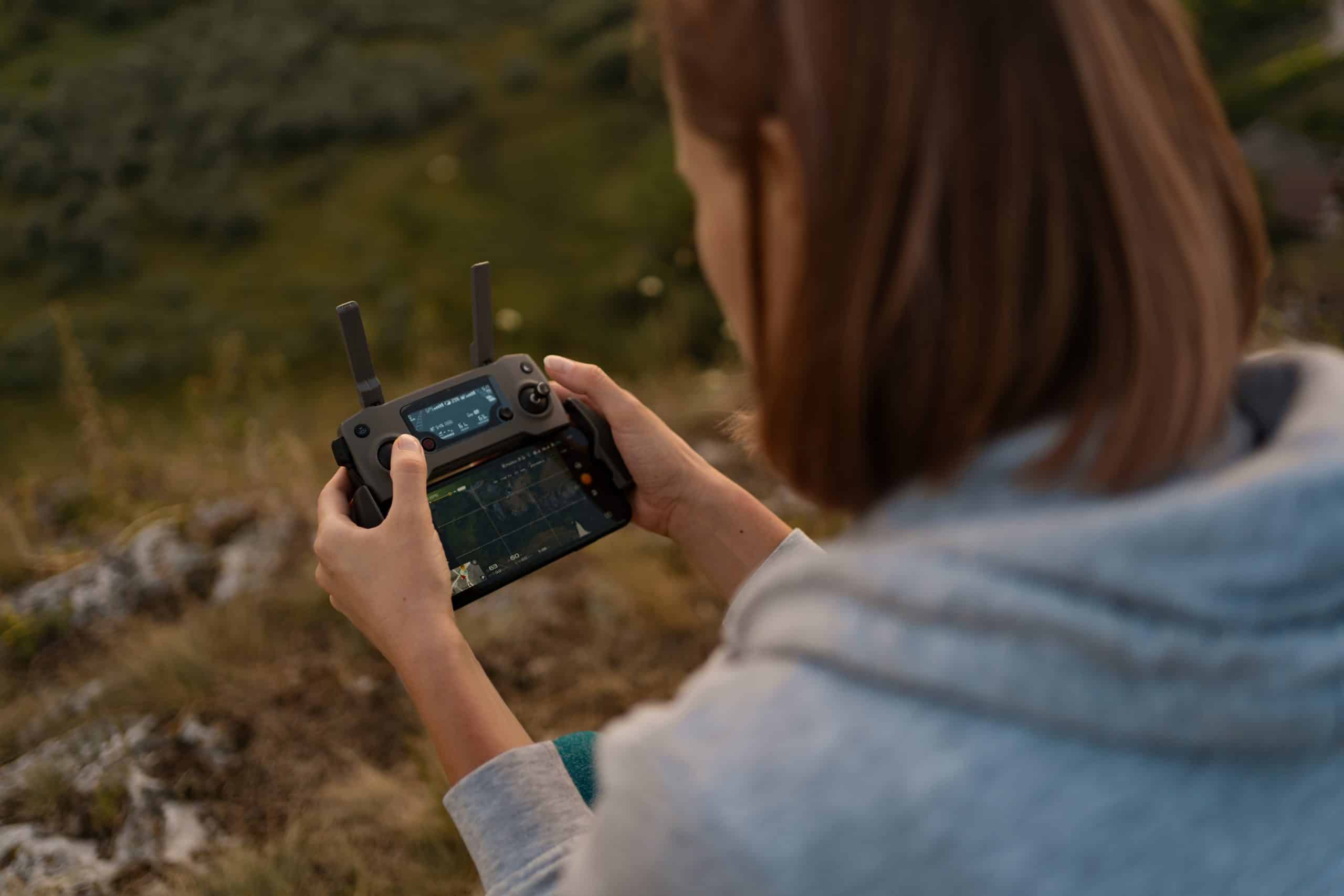
    The control station usually consists of 3 elements or controls of a drone, including the radio transmitter and receiver, the data management components and the remote control. The remote control is one of the components that you will need to familiarise yourself with when you are learning how to fly a drone for the first time, as it will be the one that allows you to control the drone precisely.

    Landing gear

    This is one of the most important parts to ensure the integrity of the drone when it comes into contact with the ground. The landing gear is a structure that goes on the bottom of the drone, which allows you to maintain an adequate distance between the body of the drone and the ground. This is essential for drones that carry some kind of suspended load, such as a camera, an irrigation system, spraying or any other complement that is required to execute the main uses of professional drones.

    Add-ons

    There are other types of parts of a drone that are not commonly installed in the UAV, but are incorporated additionally depending on the activity to be carried out. Such is the case of cargo drones or drones used to perform light shows with drones, to which add-ons are installed to allow the activity to be carried out normally.

    All of these parts are fundamental to the design of a drone and allow the pilot to control every aspect of the flight safely.

    Drawing of a drone and its parts

    In the following diagram you can see what the parts of a drone are and where they are located in a quadcopter, which is one of the most popular commercial models today.

    1. Frame
    2. Arms.
    3. Landing body.
    4. Camera.
    5. Battery.
    6. Motor.
    7. Gimbal.

    Drone drawing

    Parts of a racing drone

    Racing drones have some additional add-ons, but some parts are also discarded, as these are not conventional RPAS, but FPV (First Person View) drones. In this case, the main components of the drone will be the basic ones, so that the drone is as light as possible and can offer an immersive flight experience.

    Therefore, one of the essential parts of the racing drone, besides the camera, is the FPV goggles. These are connected to the drone’s camera and control station, so that the pilot can see in real time the images that the camera is capturing, with a first-person view.

    Usually racing drones tend to have more moving parts, so that repairs can be made in the event of a hard crash. These include motor mounts, independent arms, motor and gimbal control unit, among others. But parts that are not useful for racing, such as GPS systems or sensors, are omitted.

    If you want to learn how to assemble your own drone or make repairs to it, it is advisable that you join our advanced drone mechanics course, which is one of the specialised drone courses that we offer at UMILES. This way you can learn how to assemble a drone and obtain all the necessary certifications to become a professional drone assembler and repairer.

    What are the parts of an agricultural drone?

    Agricultural drones include the basic parts of a drone, such as the frame, camera, sensors, GPS and battery. However, the cameras used in agriculture are usually not the traditional ones. They are usually equipped with multispectral cameras, which sense different spectrums of light to detect pests or diseases in crops, identify areas of water stress and provide specific information to help manage crops more efficiently, which helps improve productivity and reduce costs.

    What material is a drone made of?

    The material from which the components or parts of a drone are made is essential for them to fly efficiently. Each part must be made of lightweight and resistant materials that are able to withstand impacts without breaking easily.

    Usually, drone parts are made of lightweight materials such as plastic or carbon fibre to keep the weight of the drone as low as possible. Carbon fibre is one of the most commonly used materials in drone manufacturing because of its high strength and light weight and is commonly used in the drone’s structure or frame.

  • Drone identification plates. Are they necessary in 2023?

    Drone identification plates. Are they necessary in 2023?

    One of the main questions that arise among UAS owners and among our students of the professional drone pilot course, is whether or not it is mandatory to carry identification plates for drones. Mainly, the implementation of the European regulations on RPAS regulation in Spain, has caused a lot of uncertainty and doubts about what these drone plates should contain.

    That is why on this occasion we will try to clarify all the doubts you may have about this drone plate or number plate, and all the legal aspects that govern this type of identification elements in this 2023. So if you want to work as a drone pilot, this is of interest to you.

    What is the registration plate of a drone?

    Drone identification plates, popularly known as drone number plates, are identification elements that must be placed on the structure of the unmanned flying vehicle, where the most relevant data of the aircraft must be reflected.

    They are small plates for drones that must collect information, both from the manufacturer and the owner or pilot, in order to keep track of them and have a means of direct contact with the pilot in case the drone is lost, or in case of any eventuality that may occur.

    These personal identification plates are very useful in case of accidents and even if the drone is lost, as they allow you to differentiate your UAV from other models of the same batch.

    Characteristics of drone identification plates and labels in 2023

    Drone identification plates should be placed in legible and easily accessible areas, so that anyone can access the information.

    Each drone identification tag must comply with a number of characteristics. Among others, the drone identification plate:

    • They must be flame retardant.
    • Its demarcation can be done by stamping, die-cutting or chemical engraving, provided that the method has been approved to withstand inclement weather and that it is indelible.
    • They must contain the identification of the manufacturer and the owner written clearly and legibly.

    What data should be included on the plate of an RPAS UAS drone?

    A drone registration or plate must contain basic UAS identification information, including data provided by both the manufacturer and the owner. Among the data on the drone identification plates that these plates must contain are:

    • Drone type.
    • Drone model.
    • Serial number.
    • Name of the pilot.
    • Aircraft owner’s contact details (telephone number and email address).

    In certain cases, the label is required to include the registration number of the UAS operator, depending on the category in which the UAV is classified. This must therefore be included:

    • When it is a drone with MTOM of 250 grams or more.
    • When it is an aircraft equipped with personal data capture sensor.
    • In all aircraft used within the “Specific Category”.
    • In other cases that may be added according to the latest regulations in force at any given time.

    Are identification plates compulsory on my drone?

    The old drone regulations established in Royal Decree 1036/2017, made a clear distinction between the types of drones according to their use, taking into account whether they were used for recreational and professional use, so not all aircraft were required to carry this identification.

    Identification plates for drones

    However, with the entry into force of Implementing Regulation (EU) 2019/947, changes have been implemented that affect all types of drones equally without making this distinction. Therefore, identification plates are required for recreational and professional drones alike.

    This means that a 2023 drone identification plate is required, although there are some exceptions as detailed below.

    Which drones have to carry identification plates?

    As previously mentioned, virtually all drones for both professional and recreational use will be required to carry an identification plate. That is, drones that are used for aerial filming or for drone shows must carry such drone plates. Only drones that are considered as toys are exempted from this requirement.

    Class identification label

    Another requirement that comes into force from 31 December 2020 with the implementation of the Implementing Regulation (EU) 2019/947, is that drones must be correctly identified with the “Class” to which they belong.

    Remember that the European regulation establishes up to 6 classes of UAS, among which clear distinctions are made for their use in the different categories (open, specific and certified). Therefore, drones without class identification that have been placed on the market before 1 July 2022 (with some exceptions) will be allowed to be used.

    As of the latter date, manufacturers are obliged to ensure that all their drones have the class identification label from the moment they are manufactured, as established in the current legal regulations. Therefore, the drone identification plate will be mandatory.

  • GPS in Drones: What it is for and when to use it

    GPS in Drones: What it is for and when to use it

    The geopositioning system in drones plays an important role, as it allows the drone to perform its functions more accurately and safely. That is why in this article we will discuss everything related to drones with GPS, and its importance for the execution of a wide variety of actions.

    What is GPS?

    GPS (Global Positioning System) is a satellite system that allows you to determine the precise geographical location of an object anywhere in the world.

    Basically, it works thanks to a network of satellites orbiting the Earth that transmits signals to receiving devices, which use these signals to triangulate their exact position.

    What is GPS

    What does GPS do in a drone?

    GPS in a drone allows its precise location to be known at all times. It acts as a navigation and positioning system, providing crucial information to the pilot or flight control software.

    With the help of GPS, a drone can fly with complete autonomy, follow predefined routes with precision and maintain a stable position, as it will be able to determine its surroundings in real time.

    What is GPS used for in a drone?

    GPS in drones has several applications and benefits for navigation. Among the most relevant we can mention:

    • Accurate navigation: GPS enables a drone to move precisely and maintain a stable position. This is essential for high-quality aerial drone video or photography, as well as for precise mapping of areas, as in the case of drone photogrammetry.
    • Autonomous flight: The GPS signal in drones allows them to follow programmed routes autonomously. This is especially useful in inspection, crop monitoring, search or rescue tasks, as it can follow a specific pattern. This function is essential for irrigation and spraying drones in agriculture.
    • Safe return home: If a drone loses connection with the remote control or its battery is low, GPS allows the drone to automatically return to its take-off point.
    • Limitations: GPS allows virtual geographic boundaries, known as geofencing, to be set that restrict the drone’s flight area. This is useful to ensure that the drone does not stray too far or enter restricted areas, such as SPAs, SACs and SCIs zones.

    Main uses of GPS drones

    GPS-equipped drones have a wide range of uses, including:

    • Aerial photography and videography:  GPS allows drones to remain stable in the air, resulting in smooth, high-quality aerial shots. This is valuable for cinematography drones, event photography and landscape capture.
    • Inspection and monitoring: Drones can perform inspections of infrastructure, such as power lines and pipelines, more safely and efficiently. GPS helps track the location of problems and ensure accurate analysis.
    • Precision farming: GPS-enabled drones can collect crop and soil data, enabling more efficient farm management. This includes precise fertiliser application, controlled irrigation and early detection of crop problems, using drones for agriculture.
    • Search and rescue: GPS-equipped drones can search large areas and transmit images in real time. This speeds up search and rescue operations, increasing the chances of finding lost people.

    What a GPS do in drones

    What kind of signal do drones use?

    Drones use the GPS signal, which is a radio frequency signal transmitted by satellites. This signal contains location and time information. Drones can also use other positioning systems, such as GLONASS, Galileo or BeiDou, for greater accuracy and better coverage in different regions of the world.

    Where is the GPS on a drone?

    The GPS in a drone is usually located in the GPS receiver unit, which is one of the parts of the drone that is responsible for the navigation system.

    In some cases, the GPS receiver may be built into the structure itself, while in others it may be connected via a GPS antenna on drones. The aim is to ensure that the GPS receiver has a clear view of the sky to receive the signals from the satellites without obstructions.

    Don’t forget that you can contact us to join the best professional drone pilot course, and obtain all the certifications required by the AESA so that you can perform professionally.

  • Drone Pilot License: Requirements, Regulations and Types

    Drone Pilot License: Requirements, Regulations and Types

    From the entry into force of the European UAS Regulations in 2021, the training required to fly a drone is similar in all EU countries. This means that the training you can obtain in Spain will be recognised in other EU countries, such as France, Italy or Portugal.

    There are different certifications or types of drone licenses that you can get, so it is important that before flying a drone, you are up to date with the regulations that allow you to fly drones in Spain and in Europe, and to do so, we recommend you to consult the AESA website where you can check everything you need to have before flying your drone, such as the Operator Registration, the Civil Liability Insurance and identification plates for drones.

    The AESA website where you can get an overview of the drone sector is: https://www.seguridadaerea.gob.es/en/ambitos/drones.

    What is a drone pilot licence?

    A drone licence is the certification or accreditation provided by AESA to UAS pilots so that they can operate legally and safely, following all the established parameters to avoid causing accidents or interfering with air traffic.

    What is required to obtain a drone pilot licence?

    To fly a drone, whether the purpose of your flight is recreational (to merely enjoy piloting) or to carry out aerial work, you must have a minimum amount of mandatory training.

    The new European regulation explains that drone operations are categorised according to the risk that the drone operation itself poses to people on the ground nearby. This means that, depending on the Operational Category into which your flight fits, you must have different training to be able to receive the corresponding drone licence.

    Although we are going to talk later about all the categories and types of drone pilot licence that you can obtain depending on the operation you are going to carry out, we recommend that, in order to make sure that your flight belongs to one category or another, to consult the AESA and ENAIRE Drones website to find out all the details of your operation. You will then be able to find out which type of drone certification you need to apply for.

    types of drone licence

    The different drone certificates or licences that exist today

    The UAS certifications or types of drone licence in Spain are basically classified into 3 categories, which are:

    • Drone Pilot Certificate A1-A3
    • A2 Drone Certificate
    • STS Drone Certificate

    Below we give you more details of each of the types of drone licenses you can get, according to the classification described above and their respective fields of action.

    Remot Pilot Certificate or Drone License A1-A3

    The A1-A3 drone pilot certificate is mandatory for all those who want to fly a drone, from the most basic to the most complex.

    Which drones can be flown with A1 A3?

    This A1 A3 UAS certificate allows you to fly drones up to 500 grams Maximum Take-Off Weight (MTOW) in Open Category A1.

    From January 2024, this certificate will also allow you to fly drones with Class C1 Label in the same Category. In addition, it not only includes the benefits of Open Operational Category A1, but also Open Category A3, so you will be able to fly drones up to 25kg in this operational category, and from 2024, drones of any class label, as long as you are in Category A3.

    This A1-A3 certificate is a theoretical exam type test that is done in AESA, based on a syllabus that the State Aviation Safety Agency publishes.

    A2 Remote Pilot Certificate or A2 Drone License

    This UAS certificate will allow you to fly in Open Category A2. To obtain this drone pilot certificate you must complete two parts, the first, theoretical in AESA, a test type exam, and on the other hand, a self-practical part, in which you must practice a series of manoeuvres in a controlled environment and evaluate yourself to confirm that you are qualified.

    What drones can fly with A2?

    With this certificate you will be able to fly drones up to 2kg in weight, and from 2024, drones with a Class C2 label.

    STS Remote Pilot Certificate or STS Drone Pilot License

    This drone certificate, the most difficult, but the highest level, allows you to fly under Specific Category, within the Standard Scenarios that are currently published (STS-ES-01 and STS-ES-02).

    drones license a1 a3

    Which drones can be flown with an STS certificate?

    With this professional drone licence you can fly a drone weighing up to 10kg in urban areas and VLOS (Visual Line of Sight) under the STS-ES-01 standard scenario and up to 25kg in BVLOS (Beyond Line of Sight) under the STS-ES-02 standard scenario. From January 2024, you will be able to fly drones with Class C5 and C6 Label respectively for each Scenario. It will consist of a test part to be carried out at AESA, and a practical part to be carried out at a Training Entity recognised by AESA.

    How to obtain a drone licence from AESA?

    To obtain an AESA drone licence, you need to check which level of the State Aviation Safety Agency’s training scheme your UAS is at. For more details about each corresponding drone pilot certificate according to that classification, we invite you to enter our blog article dedicated to how to get a drone licence, where we explain everything you need to know to get a drone pilot licence.

    From UMILES we recommend you to obtain all the certificates to be able to fly in any possible scenario and above all, it is very important that you know the limitations of each operational category (Open, Specific), so that you know what type of flight you are going to do, the limitations, and more importantly, if you have the necessary qualifications to operate in those conditions.

    How much does it cost to get a drone pilot licence?

    Certification prices will depend on the number of requirements that need to be met. For example, in the case of drones with MTOW of less than 250g, the pilot can register for free on the AESA electronic platform, and that will be enough to fly the drone.

    However, in cases where it is necessary to take a professional drone pilot course or training to obtain STS certifications, you will have to pay the price corresponding to each of the modules in which you want to specialise.

    Below are some indicative references:

    • Drone pilot certificate A1-A3: The price of the theoretical exam and the issuance of the certificate by AESA is usually around 200-300 euros. In addition, you may have to invest in study material or preparation for the exam.
    • A2 drone pilot certificate: For this certificate, the price can be similar to the A1-A3 certificate, as it also involves a theoretical exam and the issuance of the certificate by AESA. In addition, you may need to invest in the practical part of the training by taking a course like the ones we offer at UMILES University.
    • STS drone pilot certificate: This certificate, being of a higher level and requiring more specialised training, may have a higher price. In addition to the theoretical exam, you will need to complete practical training at an AESA-recognised entity, such as UMILES University.

    What does it take to become a drone pilot?

    To become a drone pilot, you need to meet certain requirements and follow a training and certification process. The steps are as followed:

    1. Undertake theoretical training: You must complete a theoretical training course that covers the knowledge necessary to operate a drone safely and legally. This training covers topics such as aviation regulations, drone-specific regulations, meteorology, flight principles, navigation and safety.
    2. Pass the theoretical exam: After receiving the theoretical training, you must pass a theoretical exam administered by the relevant civil aviation authority in your country, such as the Spanish State Aviation Safety Agency (AESA) in Spain. The exam will test your knowledge of the theoretical aspects related to drones and their operation.
    3. Take a course with real drone practice: In addition to theoretical training, some drone pilot certificates require practical training. This involves acquiring piloting skills through supervised flight practice in a controlled environment. During this stage, you will learn how to control the drone, perform basic manoeuvres and become proficient in different flying situations.

    Once you have completed these steps and obtained your drone flying certificate, you will be able to operate legally in multiple situations.

  • UMILES, plays a main role at the wedding of Tamara Falcó and Iñigo Onieva

    UMILES, plays a main role at the wedding of Tamara Falcó and Iñigo Onieva

    Enormously grateful to be able to announce that we performed a light show with drones at the most anticipated wedding of the year.

    Tamara Falcó and Iñigo Onieva counted on the UMILES business division that is in charge of performing choreographies with drones in the sky. An innovative, sustainable and noiseless option that makes many companies or individuals have it present in many of their evening events.

    The couple along with their 400 guests were able to see first hand a drone light show prepared exclusively for them. They were able to see a combination of abstract figures along with figures representing the relationship and love between the two.

    The sky was illuminated with 200 drones and they could see figures such as their initials, the silhouette of El Rincon, a 3D heart palpitating, an infinity representing the love there is, among many others. The drone show not only commemorates their union as a couple, but also the symbolism of the Marquisate of Griñón.

    A challenge that for Drone Light Show is always possible. It had the whole team in the creation process. From the proposal to the design, including the tests performed at UMILES private airfield.

  • What is the maximum height and distance a drone can fly?

    What is the maximum height and distance a drone can fly?

    If you have thought about buying a drone, either for professional or recreational use, you will surely have many doubts about its operation. One of the first questions that are generated among the students of our drone courses who begin to familiarize themselves with this type of devices is “how high can a drone fly?”

    This is a fact that you should know to avoid scares or fines, so that you can get the most out of your new acquisition. That is precisely why this time we will talk about the range of a drone in the different categories of use. However, as regulations can change, we recommend that you always refer to official sources and regulations.

    In order to comply with current regulations, it is not only important to know where you can fly drones, but it is also essential to know the maximum height and displacement limits that are allowed when performing this activity.

    Drones are considered as aircrafts that move through the airspace, even though they do not carry any kind of crew. Therefore, maximum limits are established for the displacement of these aircrafts, so that their flight does not interfere with other vehicles circulating in the area.

    So, what is the maximum height allowed in Spain to fly a drone? In general, the minimum flight height of airplanes is used as a reference, which fly above 150 meters. It is for this reason that it has been defined that drone flight is performed at a height of 120 meters, so that a space of 30 meters of separation can be left between the routes of manned aircraft and UAS.

    Precisely to avoid this type of interference, no-fly zones are created, which include the areas near airports, since at these points airplanes are descending and collision conflicts with drones can be created. You can check where you can fly your drone in our blog and in ENAIRE Drones.

    What is the range of a drone?

    In addition to the maximum height at which a drone can fly, another important aspect to consider is its range, i.e. the distance it can travel from the pilot. The range of a drone can vary depending on the type of flight and the restrictions established by the regulations.

    Likewise, each drone can have a different range depending on the transmitter and the type of receiver contained in the drone. There are drones with a range of up to 4 and 8 km, although if you are wondering how much range a specific drone has, we recommend you to read the instruction manual that comes with the device as it says it there.

    In visual range flights (VLOS), the pilot must keep the drone within his direct line of sight at all times. According to the regulations, the maximum distance a drone can move away from the pilot in a VLOS flight is 500 meters. This is based on the consideration that this is the maximum distance at which a person can have an adequate field of view. However, it is important to remember that, in any case, it is not allowed to exceed the established maximum height of 120 meters.

    There are other flight categories that allow the drone to have a longer range, as long as certain requirements are met and the corresponding authorizations are obtained. For example, in authorized flights performed by certified pilots, in specific areas and with the implementation of additional safety measures, distances of between 1 and 2 kilometers can be achieved.

    It should be noted that the effective range of a drone may also depend on other factors, such as atmospheric conditions, signal interference and battery capacity. Therefore, it is essential to take all these considerations into account when planning and operating a drone flight.

    How high can a drone fly in Spain?

    In Spain, the regulations governing air traffic control and especially drone flight are based on current European regulations. That is why the maximum flight height of a drone in Spain will also be 120 meters.

    This height will always be measured from the ground where the pilot is positioned, since it is the reference point for air traffic. Therefore, slopes or hills can be considered as reference points, but the maximum height limit cannot be considered if the pilot is positioned over a building or obstacle of great height.

    At UMILES University we offer you the best drone pilot course in Madrid, so you can know in detail all the flight regulations and put into practice your skills within the maximum allowed distance.

    Is it possible to fly a drone higher than 120 meters?

    As a general rule, all drones must fly at a maximum altitude of 120 meters. Especially those flying in the open category, which includes drones classified in classes 0, 1, 2 and 3.

    Although it is important to highlight that there are certain exceptions, which must be considered by the regulatory body and may be presented under strict authorization by the EASA, only in certain geographical areas and especially in emergency or high-risk situations.

    Small elevations exceeding this height are allowed only in cases where a high elevation obstacle (exceeding 105 meters in height) must be strictly overcome, and under request of the entity responsible for the obstacle. Although in any case it must not exceed the airspace of airplanes, so an overflight above 30 cm of the established limits is not allowed.

    For this type of situations, the most advisable is the use of drones classified in classes 4 and 5, since as a general rule they have detection systems, which allow the pilot to know the height at which the UAS is moving, and which can be programmable with maximum and minimum flight limits to avoid any type of collision.

    How far can a drone fly?

    It has already been made clear what is the maximum height at which a drone can fly. But if we consider the distance, it varies according to the type of flight allowed for each pilot. The most common are the VLOS flights, which are those included in the open category, in which the pilot must never lose sight of the drone.

    In this case, the maximum distance at which the drone can be moved away from the pilot will be 500 meters, since it is considered that this is the maximum distance at which a person could have an angle of view. But in no case it is allowed to exceed the maximum height limit set at 120 meters.

    There are other types of flights that allow between 1 and 2 kilometers, as long as the flight has been authorized, is performed by certified pilots and meets the requirements of observers strategically located at equidistant points. In any case, the best thing to do is to refer to the current and most current regulations.

  • Where can I fly my Drone? Regulations to fly drones in Spain 2023

    Where can I fly my Drone? Regulations to fly drones in Spain 2023

    Drones have gone from being interesting recreational objects to important tools for the development of all kinds of activities. From light shows with drones, to aerial filming systems for commercials, movies and series.

    Their functionality is such that they have become a growing market increasingly in demand. That is why regulations have been created to regulate the conditions of use of these aerial vehicles, and especially the areas where flying drones is allowed, as well as approved drone courses.

    In Spain, the State Agency for Aviation Safety (AESA), ensures compliance with civil aviation standards in all aeronautical activity in Spain, both manned and unmanned aircraft, defining the areas where you can fly a drone.

    Regulations governing the use of drones in Spain

    As Spain is an EU Member State and belongs to the group of countries under the tutelage of EASA (European Aviation Safety Agency), it must comply with the European Regulations 2019/947 and 2019/945, which establish everything related to the use of drones in the airspace.

    This regulation catalogs drones in 3 categories (open, specific and certified), according to the risk of the operation.

    • The open category is where most of the operations are included, which are low risk operations.
    • The specific category includes those drones that perform medium risk activities.
    • The certified category includes drones that perform high-risk tasks and must follow more precise guidelines.

    For each of these categories, special norms and rules are established that must be complied with in order to avoid being sanctioned for non-compliance with the law. . That is precisely why it is important to learn which are the zones where drones can be flown and their restrictions.

    You can find more information in our article on European drone regulations.

    Zones allowed to fly drones in Spain – Guidelines to apply

    Drone flight zones are defined according to the basic guidelines that these unmanned aircraft must comply with. For the particular case of Spain, in addition to the European regulations already mentioned above, a national regulation (RD1036/2017) must be followed, which is partially repealed, but for the time being must be partially complied with.

    In a general sense, the regulations for flying drones define that all UAS used in Spanish airspace must comply with the following rules, regardless of whether they are used for recreational or professional purposes:

    • The pilot must have visual contact with the drone, except for those drones that are included in the specific category with permission to perform BVLOS operations (beyond the visual range of the pilot).
    • The flight may not exceed 120 meters in altitude.
    • It is not allowed to fly the drone near any airport or airfield except in coordination with the infrastructure manager.
    • It is only allowed to fly in Controlled Airspace or Flight Information Zone to professional aircraft, after coordination of an Operational Risk Assessment with the Air Navigation Service
    • Provider of the area and a subsequent operation request.
    • All drones must have a fireproof identification plate, indicating the manufacturer’s name, model, serial number and operator’s data, in addition to the operator’s registration number.
    • Devices that include cameras or microphones must respect people’s right to privacy, so care must be taken not to violate the Data Protection Law in case of disclosing images of people without their authorization.
    • The respective flight certificate must be held according to the category in which the operation is located.

    Remember that with our professional drone pilot course you will obtain the official certifications necessary to be a competent pilot at a technical level anywhere in Europe and operate in a safe environment.

    Where can I fly my drone?

    Among novice pilots it is common to have doubts such as: where can I fly my drone? or how do I know where can I fly my drone?

    If you have doubts about the places to fly drones allowed in Spain, you can consult the ENAIRE Drones website. This is the entity in charge of managing air navigation in Spain, and they have taken the time to mark the flight zones for drones allowed in the country.

    Using ENAIRE’s web service, you will be able to get accurate and updated information about the places near your location that you should avoid, as well as those areas where you can fly a drone, or the places where you will require special permissions.

    You will only have to provide certain information requested by the platform, and you will be able to obtain precise and very useful data so that you can know in advance the areas allowed to fly drones, as well as the restrictions of your aerial operation.

    Where can a drone weighing less than 250 grams be flown?

    Drones weighing less than 250 grams enjoy certain freedoms when it comes to flying, as no drone license is required, nor is prior authorization required as per Implementing Regulation (EU) 2019/947. However, even for this type of small drone, there are certain requirements when flying:

    • The pilot has the responsibility to ensure that the drone is kept at a safe distance from people and to avoid flying over crowds.
    • Throughout the flight, the pilot must maintain constant visual contact with the drone (VLOS), except when in “follow me” mode or using an intermediate observer.
    • The maximum allowable altitude must not exceed 120 meters at any time.
    • In addition, it is forbidden to transport dangerous goods or throw any kind of material from the drone.

    Map for flying drones in Spain by ENAIRE

    ENAIRE Drones offers you a map that shows you the areas where you can fly your drone and the restrictions they have. It is also an ideal tool for planning your routes, as it allows you to draw guidance patterns and measure distances to be flown.

    Thanks to the information shown on this map where you can fly a drone, you can plan your routes safely, without exposing yourself to penalties for violating airspace restrictions in Spain.

    So if you want to fly drones in Madrid or anywhere else in Spain, you can use the ENAIRE Drones service where you can fly a drone safely and freely according to the regulations in force.

    How much is the fine for flying a drone?

    In Spain, penalties for violating the rules on the use of drones can result in fines of varying amounts. These penalties range from €60 to €225,000 for the most serious cases.

    It is important to take into account that the infractions may be related to flying in restricted areas, exceeding the permitted height limits, flying over crowds of people or not complying with the requirement to maintain visual contact with the drone, among others. Therefore, we always recommend you to consult the ENAIRE map attached above in this article updated to 2023.